叉
Character Story & Explanation
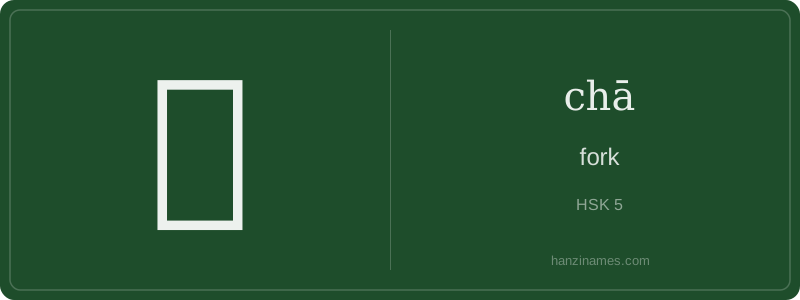
In daily life, 叉 most commonly appears in verbs like 叉腰 (chā yāo, 'to stand with hands on hips')—a culturally resonant posture denoting impatience, authority, or defiance, widely depicted in film, opera, and social media memes. It also appears in the interjection 叉!(chā! — a mild, humorous exclamation akin to 'Oops!' or 'Whoops!', documented in contemporary internet slang since the early 2010s). Historically, 叉 was used in technical texts like the *Tiangong Kaiwu* (1637) to describe agricultural forks and metal-tipped tools.
The character is a clear pictograph: three strokes depict a central vertical line (the handle) splitting upward into two diverging diagonal strokes (the prongs)—a literal visual representation of a two-pronged fork. This form appears unchanged since the Warring States bamboo slips (475–221 BCE), confirming its origin as a functional ideograph, not a later phonosemantic compound.
As an archaeologist sifting through layers of linguistic sediment, I find 叉 emerging not from oracle bones but from the bronzeware inscriptions of the late Shang and early Zhou—where it appears as a stylized forked tool, likely used in ritual food handling or agricultural work. Its three-stroke simplicity belies its functional weight: two diverging prongs anchored by a shared stem, captured with astonishing economy. This is not abstraction for art’s sake—it’s notation born of necessity, a visual shorthand for division, separation, or piercing.
The radical 又 (‘again’, ‘also’) anchors 叉—not as semantic driver, but as structural scaffold. Unlike radicals that convey meaning directly (e.g., 刀 for knives), 又 here serves orthographic stability, a recurring frame for characters involving manual action or repetition. Early bronze script variants show subtle variations in prong angle, suggesting regional scribal habits rather than semantic shifts—evidence that form was standardized before meaning fully lexicalized.
By the Han dynasty, 叉 had solidified into a verb meaning ‘to pierce’ or ‘to fork’, appearing in texts like the *Shuōwén Jiězì* (121 CE) as ‘a tool with two prongs’. Its phonetic evolution—chā (primary), chá (rare, dialectal), chǎ (even rarer, poetic or archaic)—mirrors tonal divergence in Middle Chinese, preserved in modern Mandarin only where context demands emphasis on bifurcation (e.g., 叉腰 chā yāo, ‘hands-on-hips stance’). No mythical origin story survives—just pragmatic etymology etched in bronze and ink.
Example Sentences
Common Compounds
Similar Characters — Don't Mix These Up
Your First Step into Chinese Culture: Get a Chinese Name
Every journey into Chinese begins with a name. Use our free Chinese name generator to create a meaningful, personalized Chinese name that fits you perfectly.
Get My Chinese Name →