嗯
Character Story & Explanation
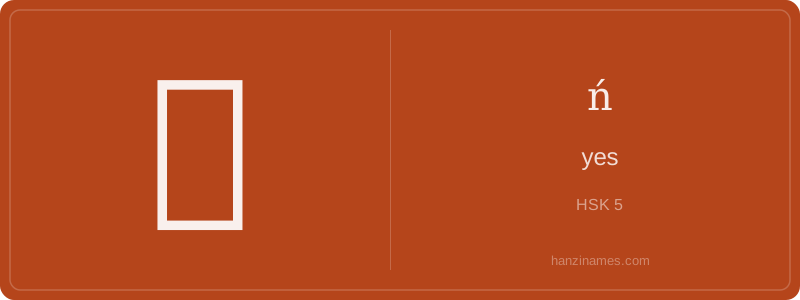
嗯 is ubiquitous in modern Mandarin spoken and written communication — especially in informal contexts like WeChat messages, subtitles, and dialogue-heavy literature. Linguists note its high frequency in conversational corpora (e.g., the Beijing University Corpus), where it functions as a discourse particle signaling listener feedback, not lexical content. It appears in no classical idioms (chéngyǔ), nor in formal documents — its role is purely pragmatic and oral. Real-world usage includes affirming instructions ('嗯,知道了' — 'Okay, got it') or softening refusals ('嗯…我再想想' — 'Hmm… I’ll think about it').
The character is a late-developing phonogram: 口 (mouth) + 恩 (ēn, 'grace/favor', here used solely for sound). It has no ancient pictographic origin — it was created during the Ming–Qing period to transcribe colloquial speech sounds, reflecting how Chinese writing adapted to capture spoken nuance. No oracle bone or bronze script forms exist for 嗯.
Hi students! Today we’re learning 嗯 — a tiny but mighty character that’s not about meaning in the dictionary sense, but about human connection. It’s written with the ‘mouth’ radical (口), reminding us it’s born from speech — not thought, but sound. Though it looks like a full character, it’s actually a phonetic representation of a vocalized pause or affirmation, much like 'uh-huh' or 'mm-hmm' in English. Don’t worry about memorizing it as a 'word' — think of it as punctuation for your voice.
This character is rarely used alone in formal writing, but appears constantly in dialogue, subtitles, novels, and chat apps. Its tone matters: ń (second tone) signals active agreement ('Yes, I hear you'), while en (neutral tone) often means hesitation or polite acknowledgment ('Uh… okay'). Unlike English interjections, 嗯 carries subtle social weight — skipping it can sound abrupt; overusing it may seem evasive. Tone practice is essential!
As an HSK Level 5 item, 嗯 isn’t tested for recall like verbs or nouns — it’s assessed through listening comprehension and natural conversation. You’ll hear it in interviews, podcasts, and daily chats — often repeated (e.g., 嗯嗯) to show attentiveness. It’s one of those characters that bridges textbook Chinese and real-life fluency. Mastering its rhythm helps you sound less like a learner and more like a participant in the conversation.
Example Sentences
Common Compounds
Similar Characters — Don't Mix These Up
Your First Step into Chinese Culture: Get a Chinese Name
Every journey into Chinese begins with a name. Use our free Chinese name generator to create a meaningful, personalized Chinese name that fits you perfectly.
Get My Chinese Name →