吓
Character Story & Explanation
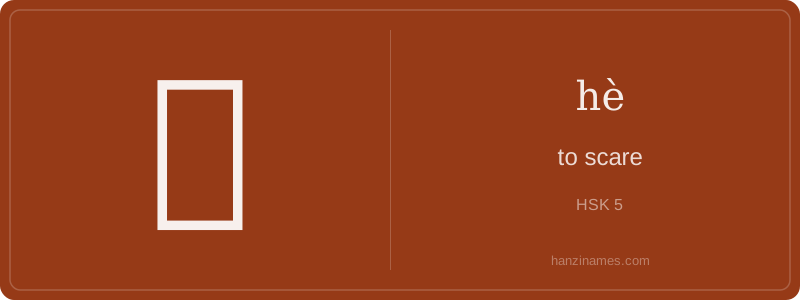
In modern Chinese, 吓 appears most frequently in spoken and written colloquial contexts as xià (e.g., 吓死我了 'You scared me to death!'), especially in exclamations and internet slang. It’s also preserved in formal/literary registers as hè — notably in the idiom 虎视眈眈,吓人一跳 (though more commonly seen in classical allusions like 'the tiger glares, making one tremble'). The *Xinhua Dictionary* (12th ed., 2020) lists both readings, confirming their coexistence in standard usage. Historical texts like the *Zuo Zhuan* use 吓 hè in diplomatic threats, while Ming dynasty vernacular novels show xià dominating informal narration.
The character is not pictographic; its origin is phono-semantic: 口 (semantic, indicating vocal action) + 下 (phonetic component, approximating ancient pronunciation). Though 下 means 'down', its role here is primarily phonetic — confirmed by *Shuōwén Jiězì*, which classifies 吓 under 口 and notes its sound relationship to 下. No archaeological pictograph evidence exists; its earliest attested form appears in Han dynasty bamboo slips as a clear compound of 口 and 下.
Our detective begins at the crime scene: the character 吓, a compact six-stroke glyph with 口 (mouth) as its radical. The mouth radical signals speech or sound-related action — fitting, since both pronunciations (hè and xià) involve vocalized expressions of fear: hè is the stern, commanding 'shout to frighten' (e.g., a general barking orders), while xià is the reflexive 'to be scared' or 'to scare' in everyday contexts. This duality isn’t arbitrary — it reflects classical Chinese’s grammatical flexibility, where voice (active vs. passive) and register (formal command vs. colloquial reaction) shaped pronunciation.
Zooming in on the right component — 下 (xià, 'down') — we find the structural clue. In ancient usage, ‘bringing down’ someone’s spirit or composure was synonymous with frightening them. This semantic link between downward force and psychological subjugation appears in bronze inscriptions and early commentaries, such as those in the *Shuōwén Jiězì* (121 CE), which defines 吓 as 'to intimidate by voice', explicitly tying 口 + 下 to vocal suppression. No mythical beast or oracle bone tale — just pragmatic linguistics: mouth + downward pressure = verbal intimidation.
Our final clue lies in phonetic evolution. While modern Mandarin distinguishes hè (high-register, literary) from xià (low-register, colloquial), Middle Chinese sources (e.g., *Qièyùn*, 601 CE) list only one reading — *hæH* — with a departing tone, used for both 'to threaten' and 'to startle'. The split into two tones and usages emerged gradually during the Yuan–Ming transition, reinforced by vernacular fiction like *Water Margin*, where 吓 hè appears in military commands, and xià dominates dialogue. This isn’t drift — it’s functional specialization, tracked in rhyme dictionaries and confirmed by linguistic corpora.
Example Sentences
Common Compounds
Similar Characters — Don't Mix These Up
Your First Step into Chinese Culture: Get a Chinese Name
Every journey into Chinese begins with a name. Use our free Chinese name generator to create a meaningful, personalized Chinese name that fits you perfectly.
Get My Chinese Name →