圈
Character Story & Explanation
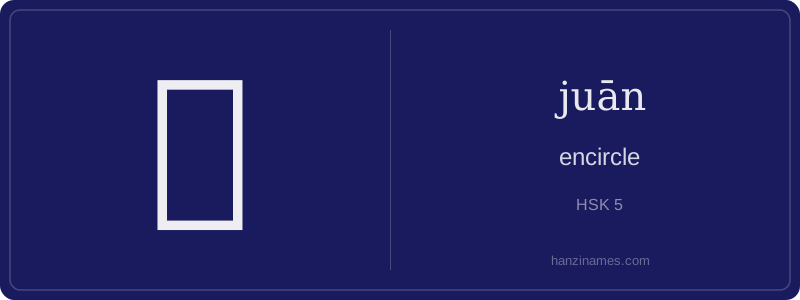
In modern Chinese, 圈 most commonly appears as quān in words like 朋友圈 (péngyǒu quān, 'WeChat friend circle')—a digital social boundary that both connects and excludes. Historically, it appears in Ming-Qing legal texts meaning 'to mark off land for imperial use' (e.g., 圈地, quān dì), a documented policy that displaced peasants to create Manchu banner estates. The idiom 自我封闭 (zìwǒ fēngbì, 'self-isolation') often pairs with 圈 metaphorically to critique ideological confinement.
The character is a clear ideograph: the outer 囗 represents an enclosing wall or boundary; the inner 卷 (originally + 倦, later simplified) evolved graphically to suggest something rolled or coiled within—visually encoding the idea of bounded space containing activity or life. No oracle bone form exists; earliest attestation is in seal script (c. 3rd c. BCE), confirming its bureaucratic origin.
As an archaeologist brushing dust from a Han dynasty bamboo slip, I find 圈 not as a cage—but as a boundary inscribed in ritual space. Its outer frame 囗 (wéi), the 'enclosure radical', appears consistently in characters denoting containment: 国 (guó, state), 囚 (qiú, prisoner), 囚 (literally 'person inside enclosure'). This isn’t abstract confinement—it’s spatial sovereignty: a marked perimeter where order begins and chaos is held at bay.
The inner component 卷 (juǎn) originally meant 'to roll up' or 'scroll'—a subtle but vital clue. In ancient land surveys and tax records, officials would 'roll up' or demarcate plots with ropes or stakes, then inscribe those boundaries on maps. Thus 圈 emerged not merely as ‘to confine’, but as ‘to formally delimit’—a bureaucratic act of authority made visible through writing.
Crucially, the pronunciation juān is rare today; quān dominates modern usage (e.g., 圈子 quānzi, 'circle' or 'social circle'), while juàn survives only in archaic or dialectal contexts like 羊圈 (yángjuàn, sheep pen). This phonetic layering mirrors China’s administrative history: the formal, written juān reflects classical governance; the spoken quān embodies lived, evolving social practice—where enclosure becomes community, and confinement transforms into belonging.
Example Sentences
Common Compounds
Similar Characters — Don't Mix These Up
Your First Step into Chinese Culture: Get a Chinese Name
Every journey into Chinese begins with a name. Use our free Chinese name generator to create a meaningful, personalized Chinese name that fits you perfectly.
Get My Chinese Name →