均
Character Story & Explanation
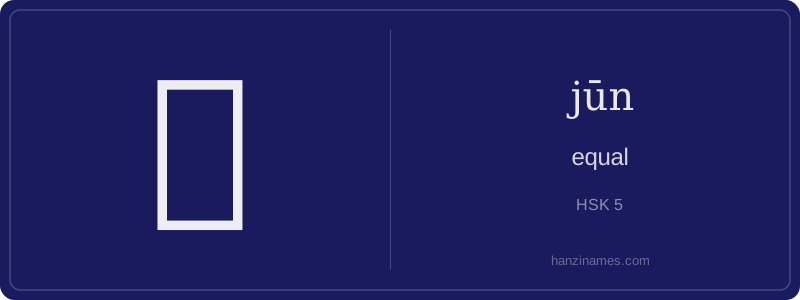
In contemporary Chinese, 均 appears ubiquitously in official, academic, and statistical contexts — especially in phrases like 人均收入 (per capita income) and 教育资源均衡 (balanced educational resources), central to China’s 2010–2035 national education equity policies. It’s also in classical idioms like 势均力敌 (shì jūn lì dí, 'forces evenly matched'), recorded as early as the Warring States period in texts like the *Zuo Zhuan*.
The character’s form has no verified oracle-bone script ancestor; its earliest attested form appears in bronze inscriptions of the late Zhou dynasty as a compound of 土 and 匀, signifying ‘land-distribution equilibrium’. Today, Chinese students encounter it first in HSK 5 vocabulary lists, often while studying socioeconomic reports — where 均 reliably marks quantifiable parity.
Our detective begins at the crime scene: the character 均. First, observe its structure — a left radical 土 (earth/soil) and right component 匀 (yún, 'even' or 'uniform'). This isn’t coincidence: in ancient China, fairness in land distribution was foundational to governance and taxation. The 土 radical signals that ‘equality’ here was rooted in tangible, territorial justice — not abstract philosophy, but measured fields, shared harvests, and balanced tribute.
Zooming in on the right side, 匀 evolved from an older form meaning ‘to regulate’ or ‘to distribute evenly’, with its own 土-like base plus symbols suggesting balance (like a scale or leveled surface). By the Han dynasty, 均 had crystallized into a bureaucratic term for standardized quotas — grain levies, corvée labor days, even military conscription. Its seven strokes were codified early, reflecting efficiency: no flourish, only function.
Modern usage preserves this legacy: 均 implies *measurable* equality — not idealistic sameness, but proportionate, calibrated fairness. It appears in statistical reports (人均GDP), legal texts (均等权利), and education policy (均衡发展). Unlike 平 (píng, ‘peaceful/equal’), which carries moral weight, 均 is technical, quantitative, and institutional — the quiet hum of systemic balance, not the shout of revolution.
Example Sentences
Common Compounds
Similar Characters — Don't Mix These Up
Your First Step into Chinese Culture: Get a Chinese Name
Every journey into Chinese begins with a name. Use our free Chinese name generator to create a meaningful, personalized Chinese name that fits you perfectly.
Get My Chinese Name →