明
Character Story & Explanation
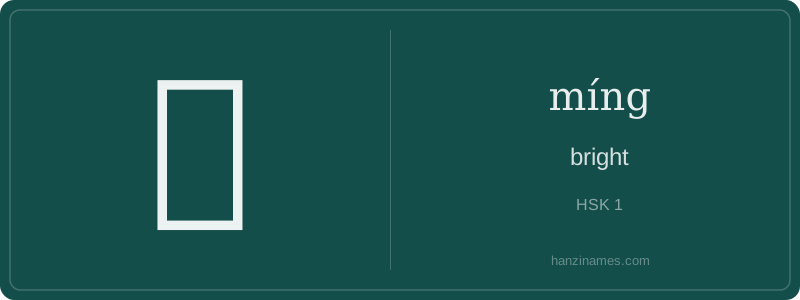
明 is ubiquitous in modern Chinese: used in time expressions (明天 míngtiān 'tomorrow'), adjectives (明白 míngbai 'to understand'), and proper nouns like the Ming Dynasty (明朝 Míng Cháo). It appears in idioms such as 明察秋毫 (míng chá qiū háo, 'to discern the finest details') and is central to Confucian ideals of enlightened governance. Historically, the dynasty’s name was officially declared in 1368 by Zhu Yuanzhang, who chose 明 to signify 'radiant virtue' and continuity with Daoist and Buddhist associations of light as wisdom and purity.
The character’s form is well-documented: oracle bone and bronze inscriptions show early versions combining 日 (sun) and 月 (moon) as independent pictographic elements. By the Warring States period, it had stabilized into its current structure—two clearly recognizable solar and lunar glyphs side-by-side, emphasizing dual-source illumination rather than hierarchical dominance.
The character 明 (míng) embodies a foundational Chinese worldview: clarity arises from harmony—specifically, the balanced interplay of opposites. Its composition—'sun' (日) and 'moon' (月)—reflects the ancient cosmological principle of yin and yang: daylight and darkness, activity and rest, visibility and mystery. This isn’t mere duality but dynamic complementarity; true understanding emerges only when both forces coexist and illuminate each other.
Historically, 明 symbolizes more than physical light—it signifies moral lucidity, intellectual insight, and political legitimacy. The Ming Dynasty (1368–1644) adopted this character precisely to evoke restoration of righteous rule after Mongol governance, framing their reign as a ‘bright’ return to Han Chinese cultural order and Confucian virtue. Light here is ethical, not just optical.
In daily usage, 明 retains this layered resonance: it denotes clear weather, sharp intellect, transparent communication, and even spiritual awakening. Unlike Western binaries where light often defeats darkness, 明 affirms that illumination requires both sun *and* moon—suggesting wisdom lies not in eliminating ambiguity, but in perceiving patterns within it. This quiet dialectic shapes how Chinese speakers conceptualize truth, leadership, and learning itself.
Example Sentences
Common Compounds
Similar Characters — Don't Mix These Up
Your First Step into Chinese Culture: Get a Chinese Name
Every journey into Chinese begins with a name. Use our free Chinese name generator to create a meaningful, personalized Chinese name that fits you perfectly.
Get My Chinese Name →