堆
Character Story & Explanation
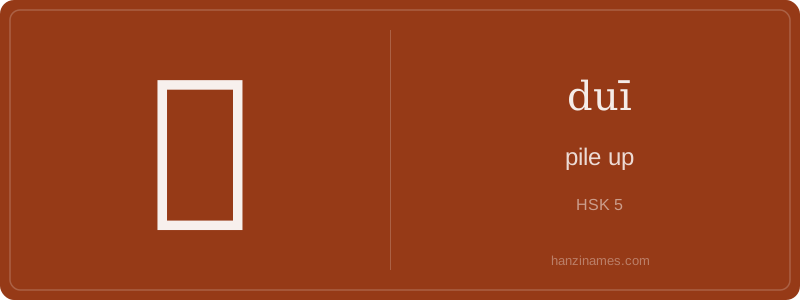
Historically, 堆 appears in Tang dynasty land registers and Ming dynasty granary accounts as a unit for bulk goods—e.g., 'one heap of rice' (一堆积米) signifying a standardized mound for taxation. It’s central in idioms like 堆金积玉 (duī jīn jī yù, 'to pile up gold and jade'), attested in Song-era texts to describe extreme wealth. Modern usage includes digital contexts: 'a heap of emails' (一堆邮件) is common in workplace Mandarin, reflecting semantic extension from physical to abstract accumulation.
The character’s form is not pictographic but phono-semantic: 土 (radical, indicating earth-related meaning) + 貴 (phonetic, approximating duī). No oracle bone or bronze inscription of 堆 exists—it first appears in seal script (c. 3rd c. BCE), likely created for administrative clarity in Qin standardization.
As an archaeologist brushing dust from a Han dynasty bamboo slip, I find 堆 inscribed in clerical script—not as a grand oracle-bone glyph, but as a pragmatic marker of material accumulation. Its radical 土 (earth/soil) anchors it in agrarian reality: grain heaps, rammed-earth fortifications, burial mounds. The right-hand component 貴 (guì, 'precious') is not about value here, but phonetic reinforcement—early scribes borrowed its sound for duī while grounding meaning in earth-bound mass.
This character emerged not from cosmology, but from logistics: tax records from Juyan (2nd c. BCE) list 'grain piles' (穀堆) by volume and location. In the *Shuōwén Jiězì* (121 CE), Xu Shen defines 堆 as 'a mound formed by piling up', confirming its functional origin. Unlike poetic characters born of metaphor, 堆 was chiseled into ledgers, stamped on clay storage tags, and inked onto grain-warehouse inventories—proof that language evolved first to count, store, and govern.
Its eleven strokes encode a quiet revolution in material culture: each horizontal stroke mimics layered strata—like sediment in a loess cliff or stacked adobe bricks along the Silk Road. Even today, when modern Chinese say 'a pile of data' (一堆数据), they echo millennia of human behavior: gathering, sorting, and containing abundance. 堆 is less a word than a fossilized verb—a linguistic stratigraphy revealing how civilization began with the simple, repeated act of stacking.
Example Sentences
Common Compounds
Similar Characters — Don't Mix These Up
Your First Step into Chinese Culture: Get a Chinese Name
Every journey into Chinese begins with a name. Use our free Chinese name generator to create a meaningful, personalized Chinese name that fits you perfectly.
Get My Chinese Name →