夕
Character Story & Explanation
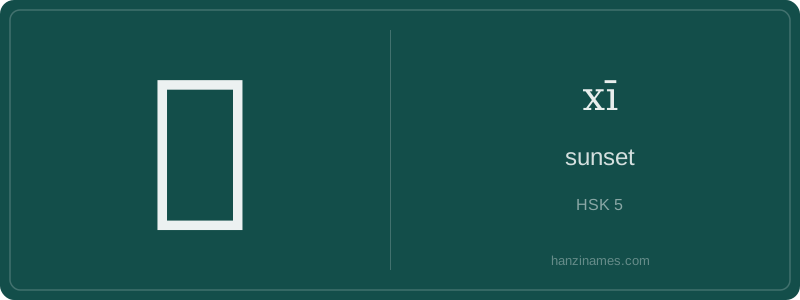
夕 appears frequently in fixed expressions tied to time and tradition. Most notably, 除夕 (chúxī) — 'Chinese New Year’s Eve' — is one of China’s most important annual observances, documented in texts like the *Book of Rites* and still central to family reunions today. Other common uses include 夕阳 (xīyáng, 'sunset') in weather reports and tourism promotions, and 夕照 (xīzhào, 'afterglow') in photography and art criticism. It also appears in formal terms like 夕刊 (xīkān, 'evening edition' of newspapers), though digital media has reduced this usage.
The character 夕 is a simplified descendant of the ancient oracle-bone script pictograph depicting the sun sinking below the horizon — a clear, documented origin. Its earliest forms show a curved line (horizon) and a dot or short stroke (sun), later stylized into today’s three-stroke shape: 丿 (piě), 一 (yī), and 乛 (zhé, a downward-right curve).
Hi students! Let’s explore 夕 (xī), a simple but evocative character meaning 'sunset' or 'dusk'. It’s only three strokes — very beginner-friendly — and serves as both an independent word and a common radical in other characters like 多 (duō, many) and 夜 (yè, night). Though small, it carries strong temporal and poetic weight in Chinese, often appearing in literature and daily expressions about evening time.
This character is classified at HSK Level 5, not because it’s hard to write, but because its usage deepens with vocabulary like 夕阳 (xīyáng, sunset) and 除夕 (chúxī, Chinese New Year’s Eve) — phrases that require cultural understanding. You’ll notice it rarely stands alone in modern speech; instead, it pairs with other characters to form precise, meaningful compounds.
Remember: 夕 isn’t just ‘the end of day’ — it evokes quiet reflection, transition, and beauty. In classical poetry, 夕 often signals emotional turning points — a farewell, a memory, or the soft light before night. As you learn more characters with this radical, you’ll start recognizing its ‘evening’ semantic thread — a wonderful pattern for building vocabulary logically and memorably.
Example Sentences
Common Compounds
Similar Characters — Don't Mix These Up
Your First Step into Chinese Culture: Get a Chinese Name
Every journey into Chinese begins with a name. Use our free Chinese name generator to create a meaningful, personalized Chinese name that fits you perfectly.
Get My Chinese Name →