妨
Character Story & Explanation
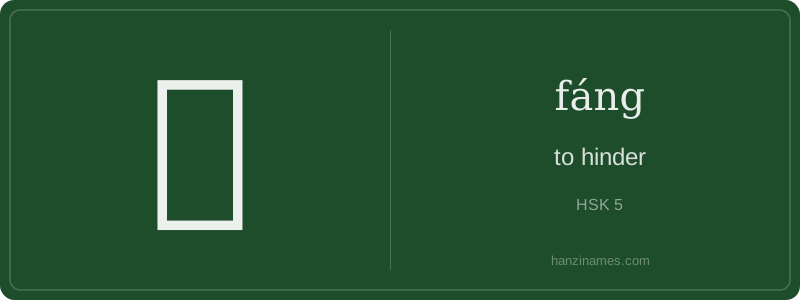
妨 appears frequently in modern Chinese in formal contexts — especially in phrases like 不妨 (bùfáng, 'might as well / no harm in') and 无妨 (wúfáng, 'it doesn’t matter / no problem'), both widely used in daily conversation and writing. These idiomatic uses soften the core meaning — turning ‘hinder’ into polite permission or reassurance. Historically, 妨 appears in classical texts like the *Zuo Zhuan* (c. 4th century BCE) to describe actions disrupting ritual order or state affairs, reflecting Confucian emphasis on harmony and non-interference.
The character is not pictographic; its earliest attested form (in seal script, c. 3rd century BCE) shows 女 + 方 — with 方 serving a phonetic role. No oracle bone or bronze inscriptions contain 妨, confirming it emerged later in the Zhou–Qin transition. Today, Chinese speakers most commonly encounter it in spoken reassurances ('不碍事,无妨!') or official notices ('此举不妨碍正常运营' — 'This measure does not hinder normal operations').
Hi students! Let’s learn 妨 (fáng), a Level 5 HSK character meaning 'to hinder' or 'to obstruct'. It’s not about physical blocking — it’s more subtle: interfering with progress, plans, health, or harmony. Think of it as an invisible speed bump in life. Though it looks simple (just 7 strokes!), its usage is quite formal and often appears in written Chinese, news reports, or official documents — less common in casual speech.
The radical 女 (nǚ, 'woman') might surprise you — but don’t assume gender bias! In ancient Chinese script, many characters with 女 were originally neutral or phonetic components. Here, 女 serves mainly as a semantic classifier linked to human behavior (not women specifically), while the right side 方 (fāng) provides sound and hints at 'direction' or 'method' — implying deviation from proper course.
Pronounced fáng (second tone — rising, like asking a gentle question), it’s easy to mix up with similar-sounding words like 房 (fáng, 'room') or 防 (fáng, 'to guard'). But remember: 妨 always carries a negative, restrictive meaning — never neutral or positive. You’ll almost always see it in compound words, rarely alone. Mastering it helps you understand warnings, policy language, and nuanced expressions of limitation.
Example Sentences
Common Compounds
Similar Characters — Don't Mix These Up
Your First Step into Chinese Culture: Get a Chinese Name
Every journey into Chinese begins with a name. Use our free Chinese name generator to create a meaningful, personalized Chinese name that fits you perfectly.
Get My Chinese Name →