威
Character Story & Explanation
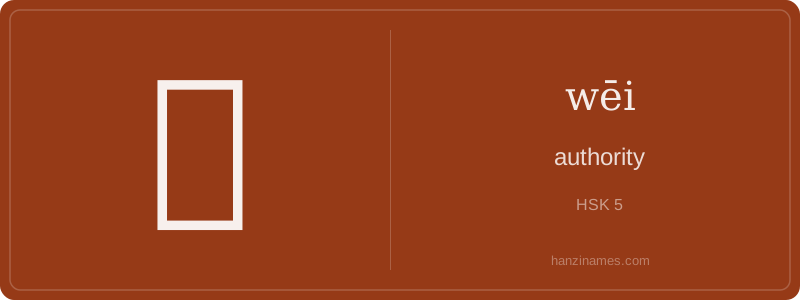
威 is ubiquitous in formal and institutional contexts: government documents cite ‘national prestige’ (国威 guówēi), courts uphold ‘judicial authority’ (司法威信 sīfǎ wēixìn), and idioms like 威风凛凛 (wēifēng lǐnlǐn, ‘imposing and awe-inspiring’) describe dignified presence. The HSK 5 curriculum emphasizes its use in abstract, high-register nouns—not casual speech. Historically, 威 appears in bronze inscriptions from the Western Zhou dynasty (c. 1046–771 BCE) as a phonosemantic compound, already carrying connotations of awe-inspiring authority.
The character combines the ‘woman’ radical (女) with 戌 (xū), an ancient weapon/axe symbol (not ‘halberd’ in later forms, but a ceremonial bronze axe signifying military authority). This pairing reflects early Zhou ideology: female-coded virtue (e.g., maternal gravity, ritual composure) fused with martial solemnity—power grounded in moral order, not violence.
The character 威 (wēi) embodies a distinctly Confucian conception of power—not brute force, but authoritative influence earned through virtue, dignity, and moral standing. In classical Chinese thought, true ‘wei’ arises when one’s conduct aligns with ritual propriety (lǐ) and benevolence (rén), inspiring awe and voluntary compliance. This reflects the East Asian ideal where authority is relational and legitimacy rests on ethical resonance, not coercion.
Historically, 威 appears in foundational texts like the *Analects* and *Book of Documents*, always paired with restraint and righteousness. A ruler without 威 is ineffective; yet one who wields it oppressively loses it—hence the phrase 威而不猛 (‘authoritative but not fierce’). This duality reveals a deep cultural skepticism toward naked domination, favoring power that calms rather than intimidates.
Modern usage preserves this nuance: 威 is rarely used alone but in compounds emphasizing legitimate influence—diplomatic威, judicial威, or parental威. It subtly critiques authoritarianism by implying that real power must be both respected and deserved. To Chinese speakers, 威 evokes quiet command, like a seasoned teacher’s glance that silences a room—not through threat, but through accumulated respect and presence.
Example Sentences
Common Compounds
Similar Characters — Don't Mix These Up
Your First Step into Chinese Culture: Get a Chinese Name
Every journey into Chinese begins with a name. Use our free Chinese name generator to create a meaningful, personalized Chinese name that fits you perfectly.
Get My Chinese Name →