娱
Character Story & Explanation
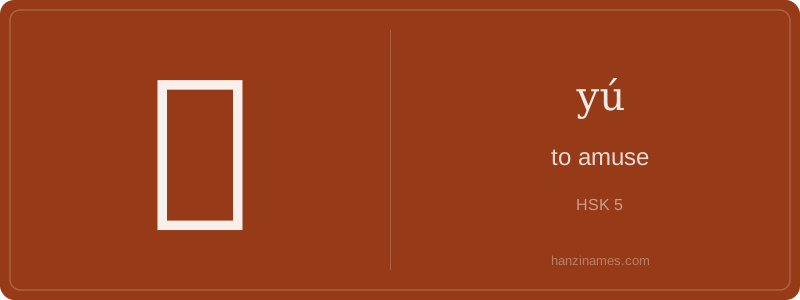
娱 is most commonly seen in the word 娱乐 (yúlè, 'entertainment'), used daily in news headlines, app names (e.g., QQ Music’s '娱乐频道'), and policy documents like China’s 'Regulations on Online Publishing Services' that regulate online entertainment content. It also appears in formal phrases such as 文娱 (wényú, 'culture and entertainment') — a standard category in Chinese government statistical yearbooks since the 1980s.
The character first appeared in seal script during the Warring States period (475–221 BCE), where it combined 女 and 吴. While 吴 originally denoted a regional state, its use here is phonetic — early forms show no pictographic link to 'amusement'. Today, Chinese people encounter 娱 constantly: on streaming platforms (爱奇艺 iQIYI’s logo includes 娱), in WeChat Mini Programs labeled '娱乐', and even in school textbooks discussing extracurricular activities.
Hello students! The character 娱 (yú) means 'to amuse' or 'to entertain'. It’s a Level 5 HSK character — so it appears in intermediate-to-advanced vocabulary. Notice its radical is 女 (nǚ), meaning 'female', which reflects historical associations: in ancient Chinese texts, entertainment often involved female performers like dancers and musicians. Don’t worry — today the character carries no gender bias; it simply conveys joyful diversion.
With 10 strokes, 娱 follows a left–right structure: 女 on the left, 吴 (wú) on the right. 吴 is both a phonetic component (suggesting pronunciation yú, though not exact) and a semantic hint — historically linked to Wu region culture known for lively music and theater. Practice writing it slowly: start with the three-stroke 女 radical, then carefully form 吴’s components: 口 (mouth) over 天 (sky/heaven).
While 娱 rarely stands alone in modern speech, it’s essential in compound words like 娱乐 (yúlè, 'entertainment') and 自娱 (zìyú, 'self-amusement'). Think of it as the 'spark' of fun — not just passive enjoyment, but active engagement: watching a show, playing games, or sharing laughter. Mastering 娱 helps you talk about hobbies, media, and leisure culture in authentic Chinese.
Example Sentences
Common Compounds
Similar Characters — Don't Mix These Up
Your First Step into Chinese Culture: Get a Chinese Name
Every journey into Chinese begins with a name. Use our free Chinese name generator to create a meaningful, personalized Chinese name that fits you perfectly.
Get My Chinese Name →