妇
Character Story & Explanation
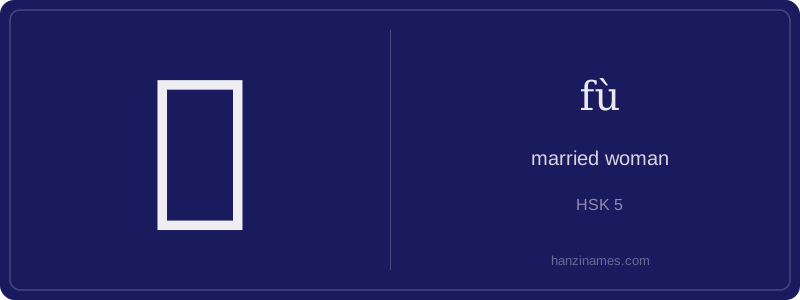
In everyday China, 妇 appears routinely on hospital signage (e.g., 妇产科 — 'Obstetrics & Gynecology Department'), in national policy titles like the Law on the Protection of Women’s Rights and Interests (《妇女权益保障法》), and in census categories such as '育龄妇女' (yùlíng fùnǚ, 'women of childbearing age'). It’s also embedded in idioms like 妇孺皆知 (fùrú jiē zhī, 'known to all women and children'), highlighting its longstanding use in formal, inclusive expressions.
The character’s form dates to the Warring States period (475–221 BCE), evolving from seal script where 女 (female) + 夫 (husband) explicitly denoted 'a woman under husband’s household'. Unlike pictographic characters (e.g., 日 for 'sun'), 妇 is a logical compound (semantic-phonetic), with 女 indicating meaning and 夫 providing both sound and conceptual framing. Modern usage retains this relational logic—always specifying a woman’s societal position, never her essence alone.
The character 妇 (fù) is a foundational term for 'married woman' in modern Chinese—distinct from the broader term 女 (nǚ, 'female'). Its six-stroke structure combines the female radical 女 on the left with 夫 (fū, 'husband') on the right, visually encoding the traditional sociological link between marriage and womanhood. Though historically tied to patriarchal norms, today it appears in neutral, official, and medical contexts—never as a standalone noun meaning 'woman' in casual speech.
Unlike English 'woman', which is gender-neutral and context-free, 妇 carries semantic weight: it implies marital status or social role. You’ll rarely hear someone say 'She is a 妇'; instead, it functions within compounds like 妇女 (fùnǚ, 'women' collectively) or 产妇 (chǎnfù, 'postpartum woman'). This reflects how Chinese lexicalizes gender through relational and functional terms rather than abstract nouns.
In contemporary usage, 妇 appears most frequently in institutional language—healthcare (妇产科 fùchǎnkē, 'obstetrics and gynecology'), policy documents (妇女权益 wòmén quányì, 'women’s rights'), and formal address (夫人 fūrén, 'madam'). Its HSK-5 placement signals that learners need it not for daily conversation, but for reading news, legal texts, and academic materials where precision about gendered social roles matters.
Example Sentences
Common Compounds
Similar Characters — Don't Mix These Up
Your First Step into Chinese Culture: Get a Chinese Name
Every journey into Chinese begins with a name. Use our free Chinese name generator to create a meaningful, personalized Chinese name that fits you perfectly.
Get My Chinese Name →