孕
Character Story & Explanation
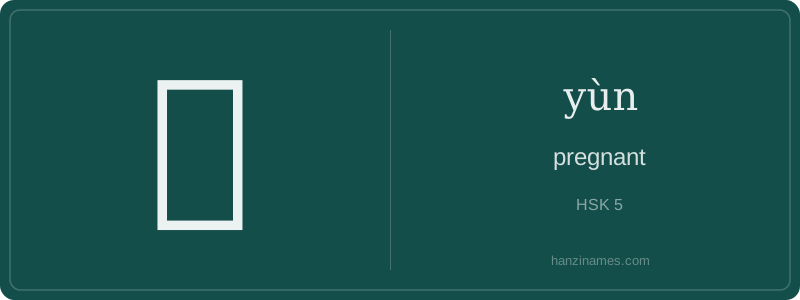
In modern Chinese, 孕 is rarely used alone in speech but appears frequently in formal, medical, or literary contexts: ‘孕检’ (prenatal checkup), ‘孕期’ (pregnancy period), and official documents like birth certificates or maternity leave applications. It also features in idioms such as ‘孕含万象’ (yùn hán wàn xiàng), meaning 'to contain all things' — a classical literary metaphor for creative potential, documented in Song dynasty poetry anthologies.
The character is not pictographic in origin; no oracle bone or bronze script precursors exist. Instead, it emerged as a phono-semantic compound in the Qin dynasty’s standardization. Today, Chinese people most commonly encounter it on hospital signage, maternal health apps, or government notices — for example, Beijing’s 2023 ‘孕产妇健康管理’ (Maternal Health Management) public health campaign used 孕 over 12 million times in digital outreach.
Our detective work begins with the radical 子 (zǐ) — 'child' — anchoring the character’s meaning in lineage and new life. The top component, 乃 (nǎi), originally a pictographic glyph representing a bent arm or vessel, evolved phonetically to suggest 'to bear' or 'to hold within.' Together, they form a semantic-phonetic compound: 子 signals the theme (offspring), while 乃 hints at pronunciation and conveys containment — as if a child is held inside.
This character first appears in standardized small seal script (c. 220 BCE), not earlier oracle bones, confirming its emergence during imperial unification when bureaucratic record-keeping demanded precise terminology for family status, taxation, and ritual roles. Its five-stroke simplicity belies its sociocultural weight: in Han dynasty legal texts like the *Juyan slips*, 孕 appears in household registers to classify women by reproductive status — critical for corvée labor exemptions and inheritance rights.
Unlike many radicals that morph over time, 子 remains visually stable across scripts — a testament to its enduring symbolic power. The stroke order (㇇, ㇏, ㇐, ㇑, ㇐) flows inward, mirroring the physiological and metaphorical 'enclosure' of pregnancy. Modern typographic rendering preserves this spatial logic: the child radical sits grounded at the bottom, while 乃 curves protectively overhead — a quiet visual covenant between body, character, and culture.
Example Sentences
Common Compounds
Similar Characters — Don't Mix These Up
Your First Step into Chinese Culture: Get a Chinese Name
Every journey into Chinese begins with a name. Use our free Chinese name generator to create a meaningful, personalized Chinese name that fits you perfectly.
Get My Chinese Name →