官
Character Story & Explanation
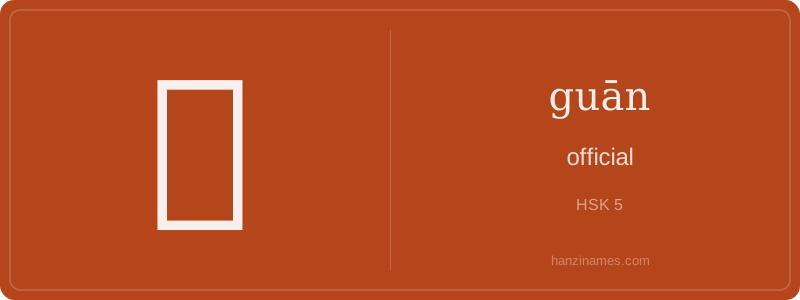
Historically, 官 was central to China’s imperial civil service system — especially after the Tang Dynasty, when the imperial examination (科举 kējǔ) selected officials based on merit. Today, 官 appears in ubiquitous terms like 官方 (guānfāng, 'official') and 官僚 (guānliáo, 'bureaucrat'). A well-known idiom is 官官相护 (guān guān xiāng hù), meaning 'officials protect each other' — reflecting enduring public discourse about accountability. Government websites, press releases, and policy documents consistently use 官 to signal authoritative sources.
The character’s earliest confirmed form appears in bronze inscriptions from the Western Zhou (c. 1046–771 BCE), where it depicted a person beneath a roof — symbolizing someone entrusted with managing affairs within a designated administrative space. While not a literal pictograph of an official, this spatial framing (roof + person/authority marker) reflects its institutional origin — verified by paleographic studies (e.g., *Shuowen Jiezi* commentary and oracle-bone/bell inscription analyses).
Hello students! The character 官 (guān) is a foundational word for understanding Chinese governance and social structure. It originally meant 'official' — someone appointed by the state to administer duties. Today, it’s used broadly: in titles like 'police officer' (警察), 'diplomat' (外交官), or even metaphorically in words like 'official version' (官方说法). Its radical 宀 (mián) means 'roof' or 'building', hinting at an official’s workplace — a government hall or office.
Don’t confuse 官 with mere 'job titles' — it carries authority, legitimacy, and institutional weight. In modern usage, it often appears in compound words rather than alone. You’ll rarely see it by itself in speech (unlike English 'official'), but it’s indispensable in formal contexts: news reports, legal documents, and historical texts. Mastering 官 helps you decode how power and responsibility are linguistically framed in Chinese society.
This character appears in HSK Level 5, meaning it’s essential for intermediate learners aiming for fluency in academic or professional settings. Though only 8 strokes, its stroke order matters: start with the roof radical (宀), then write the inner part (㠯) — not 'two people' but a stylized ancient form of 'to hold' or 'to manage'. Practice writing it slowly, emphasizing the clean downward stroke of the final 'leg' (the vertical line under the roof).
Example Sentences
Common Compounds
Similar Characters — Don't Mix These Up
Your First Step into Chinese Culture: Get a Chinese Name
Every journey into Chinese begins with a name. Use our free Chinese name generator to create a meaningful, personalized Chinese name that fits you perfectly.
Get My Chinese Name →