宿
Character Story & Explanation
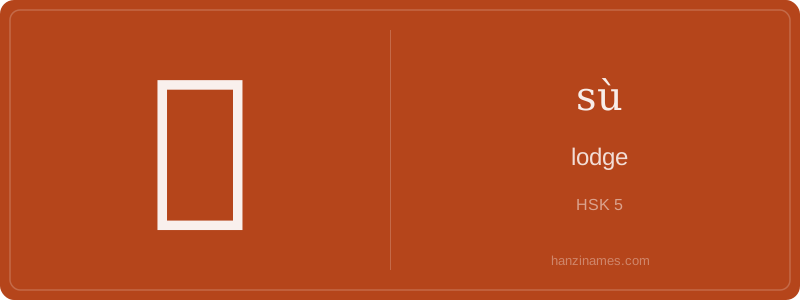
Historically, 宿 was central to China’s postal and transportation system: the Tang Dynasty’s 'post station' (驿站, yìzhàn) network included official lodgings called 宿处 (sùchù) for couriers and officials — documented in the Tang Liudian (6th-century administrative code). Today, 宿 appears in everyday terms like 宿舍 (sùshè, dormitory) and 宿营 (sùyíng, to camp), and in idioms such as 风宿露餐 (fēng sù lù cān, 'enduring wind and dew'), describing hardship endured while traveling. It’s also used in formal contexts like 宿愿 (sùyuàn, 'long-cherished wish'), extending its 'lodging' metaphor to time-bound aspirations.
The character evolved from seal script, where 宀 (roof) shelters (an early form of 朔, indicating sound and possibly lunar timing). It is not a pictograph but a phono-semantic compound — no oracle bone form survives. In modern life, students commonly say '我今晚不回宿舍' (Wǒ jīnwǎn bù huí sùshè, 'I won’t return to the dorm tonight'), anchoring 宿 in lived, intergenerational experience.
The character 宿 (sù) embodies a profound Chinese worldview where shelter is not merely physical but deeply relational and temporal. To 'lodge for the night' implies temporary yet intentional belonging — a pause in life’s journey that honors both vulnerability and hospitality. This reflects Confucian values of proper conduct in transient roles: guest, host, traveler, or sojourner. The act of lodging carries moral weight — it’s where trust is extended, rites observed, and human connection renewed under one roof.
Its radical 宀 (mián), meaning 'roof' or 'house', anchors the character in domesticity and protection, while the phonetic component 朔 (shuò, originally 'first day of the lunar month') evokes cyclical time — nights that recur, seasons that turn, lives that pass through thresholds. Thus, 宿 bridges spatial safety and temporal impermanence, echoing Daoist acceptance of transience and Buddhist mindfulness of the present moment as a fleeting abode.
In classical literature and imperial administration, 宿 denoted designated rest stations along post roads — not just places to sleep, but nodes in a civilizational network ensuring communication, order, and cultural continuity. Even today, its use in terms like 宿舍 (dormitory) or 宿营 (camping) retains this sense of sanctioned, communal pause. To ‘lodge’ is thus to participate in a shared rhythm of movement and rest — a quiet affirmation that humanity thrives not in permanence, but in thoughtful, respectful passage.
Example Sentences
Common Compounds
Similar Characters — Don't Mix These Up
Your First Step into Chinese Culture: Get a Chinese Name
Every journey into Chinese begins with a name. Use our free Chinese name generator to create a meaningful, personalized Chinese name that fits you perfectly.
Get My Chinese Name →