宝
Character Story & Explanation
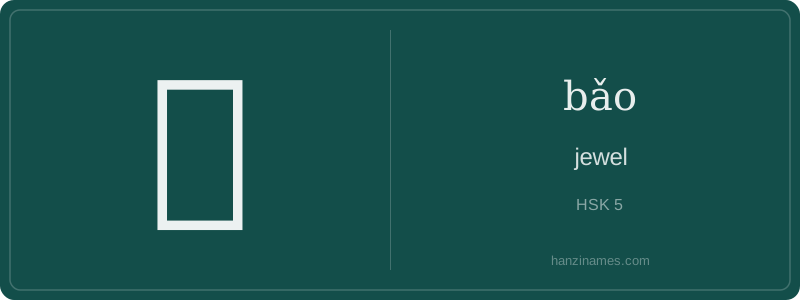
In daily life, 宝 is ubiquitous: used affectionately as ‘bǎo’ in terms like 宝贝 (bǎobèi, 'treasure' → 'darling') for children or partners; in formal contexts like 国宝 (guóbǎo, 'national treasure') for pandas or Song dynasty paintings; and commercially in brands like 中国银行 (Bank of China)’s logo-inspired slogans. It appears in the idiom 爱不释手 (àibùshìshǒu, 'love so much one can’t put it down'), often describing prized objects.
The character’s written form is well-documented: seal script (c. 3rd century BCE) already shows 宀 above 玉 — no disputed oracle-bone origin. Archaeological evidence confirms 玉 was carved into ritual objects long before 宝 emerged, and the roof radical consistently denoted valued possessions stored in ancestral halls.
As a detective tracing 宝’s evolution, I begin with its modern form: an 8-stroke character under the 宀 (roof) radical — suggesting something precious kept safely indoors. The lower component, 玉 (yù, ‘jade’), confirms its core meaning: not just any jewel, but a culturally revered, polished stone symbolizing virtue and rarity in ancient China. This pairing isn’t arbitrary — it reflects Confucian ideals where moral worth is likened to jade’s luster and resilience.
Historically, 宝 appears in bronze inscriptions from the Western Zhou (c. 1046–771 BCE) as a logograph for ‘treasure’, often referring to ritual bronzes, jade pendants, or ancestral gifts. Unlike pictographic characters like 日 (sun), 宝 is semantic-phonetic: 宀 signals shelter/protection, while 玉 provides both meaning and early phonetic hint (Old Chinese *pˤuʔ, close to 玉’s *ŋʷrək). Its stability across millennia shows how deeply material value and moral symbolism were fused in Chinese thought.
By the Han dynasty, 宝 expanded beyond physical objects to abstract treasures — wisdom, loyalty, even imperial authority (e.g., 传国玉玺, the ‘Imperial Seal of Heaven’s Mandate’). The character’s enduring structure — roof over jade — became a visual metaphor for safeguarding what matters most. Today, that duality lives on: 宝 can mean a diamond necklace or your beloved child (宝贝, bǎobèi), revealing how language preserves cultural psychology across 3,000 years.
Example Sentences
Common Compounds
Similar Characters — Don't Mix These Up
Your First Step into Chinese Culture: Get a Chinese Name
Every journey into Chinese begins with a name. Use our free Chinese name generator to create a meaningful, personalized Chinese name that fits you perfectly.
Get My Chinese Name →