尾
Character Story & Explanation
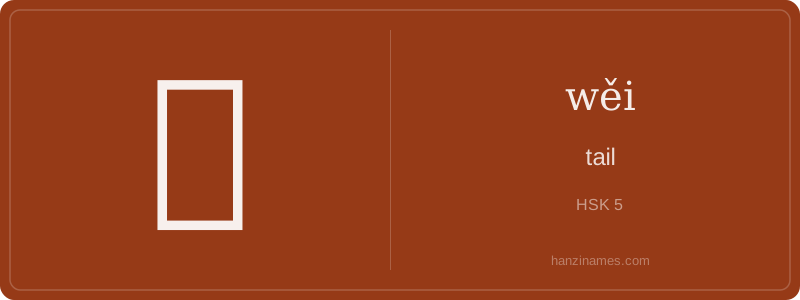
In modern Chinese, 尾 is ubiquitous in compound words denoting ‘end,’ ‘trailing,’ or ‘rear’: 尾巴 (wěiba, ‘tail’), 尾声 (wěishēng, ‘finale’), 尾气 (wěiqì, ‘exhaust gas’). It appears in technical terms like 尾矿 (wěikuàng, ‘tailings’ in mining) and idioms such as 藏头露尾 (cáng tóu lù wěi, ‘to conceal the head and expose the tail’—meaning to be half-hidden, unconvincing). Historically, it was used in imperial edicts to mark document endings (e.g., 尾批, ‘final annotation’).
The character’s form originates as a pictograph: oracle bone script (c. 1200 BCE) shows a stylized animal body with a distinct, curved line extending backward—clearly representing a tail. Bronze script variants reinforce this, with the 尸 radical anchoring the lower body and the right component evolving from 毛 (hair/fur) to emphasize the fleshy, tapering appendage.
As an archaeologist brushing dust from a Han dynasty bamboo slip, I find 尾 etched with startling clarity—not as a mere anatomical label, but as a conceptual anchor. Its earliest attested form in seal script (c. 3rd century BCE) already shows the radical 尸 (‘corpse’ or ‘body’—here functioning as a semantic indicator for the lower part of a body) paired with 毛 (‘hair’), later simplified to 屮-like strokes. This reflects ancient Chinese observation: the tail is not just appendage, but the *terminal extension* of embodied life—visible in ritual texts where 'tail' marks the end of sacrificial animal descriptions.
The character’s dual pronunciation—wěi (standard) and yǐ (archaic/rare, preserved in classical compounds like 鳞尾)—hints at phonological layering. The yǐ reading appears in pre-Qin bronze inscriptions and the *Shuōwén Jiězì* (121 CE), suggesting a now-lost dialectal or ceremonial register. Modern Mandarin retains only wěi, yet the ghost of yǐ lingers in scholarly editions of the *Zuǒ Zhuàn*, reminding us that 尾 once carried tonal weight beyond zoology—it denoted culmination, aftermath, even vulnerability (as in ‘exposed tail’ = weak point).
Excavations at Mawangdui (168 BCE) revealed medical manuscripts where 尾 appears in acupuncture contexts—specifically 尾閭 (wěilǘ), the ‘tail bone gate’, referencing the coccyx as a vital energy pivot. This transforms 尾 from passive anatomy into dynamic cosmology: the tail is where *qì* ascends or stalls. Even today, Daoist qigong manuals cite 尾閭 as the foundation of the ‘microcosmic orbit’. So this seven-stroke glyph isn’t static—it’s a fossilized kinetic concept: the body’s rearward hinge between earth and ascent.
Example Sentences
Common Compounds
Similar Characters — Don't Mix These Up
Your First Step into Chinese Culture: Get a Chinese Name
Every journey into Chinese begins with a name. Use our free Chinese name generator to create a meaningful, personalized Chinese name that fits you perfectly.
Get My Chinese Name →