屋
Character Story & Explanation
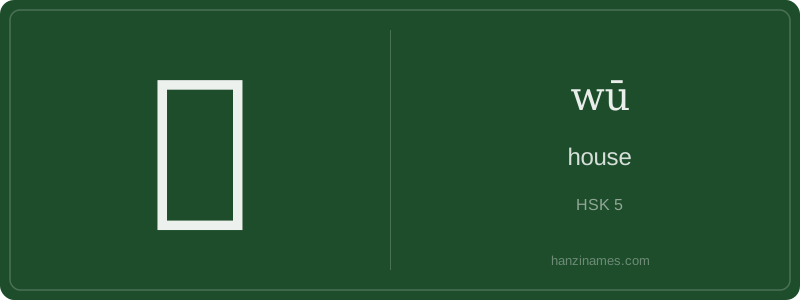
屋 appears in foundational texts like the Analects (e.g., 《论语·子路》: '居其所而众星共之' — though not using 屋 directly, its semantic field dominates classical discourse on governance-as-household). It’s ubiquitous in modern usage: real estate ads say '三居室' (three-bedroom apartment), while idioms like '屋下架屋' (building a house under a house — redundant imitation) warn against unoriginal scholarship. In Tang poetry, Du Fu laments '床头屋漏无干处' ('not a dry spot under my bed or roof'), grounding cosmic sorrow in domestic vulnerability.
Archaeologically, 屋 evolved from oracle-bone script (甲骨文) forms depicting a roof over a chamber — clearly pictographic. By the bronze script era, it standardized into the 尸 (roof/cover) + 至 (arrival, later phonetic) structure. The 尸 radical here functions semantically — not as 'corpse', but as an ancient symbol for 'sheltering cover', consistent with its use in other roof-related characters like 层 (layer, storey) and 居 (to dwell).
The character 屋 (wū) embodies more than physical shelter—it reflects the Confucian ideal of home as the foundational unit of moral and social order. In classical thought, a well-ordered house mirrors a well-ordered state; hence, ‘house’ carries ethical weight, implying responsibility, lineage, and continuity. This worldview elevates architecture into ethics: walls enclose not just bodies but values—filial piety, hospitality, ancestral reverence.
Unlike Western notions that often separate ‘home’ from ‘institution’, 屋 historically denoted both dwelling and domain—e.g., the imperial palace (皇屋) or scholarly study (书屋). Even today, compounds like 学屋 (study room) or 茶屋 (teahouse) retain this sense of purpose-built, culturally charged space. The roof radical 尸 (originally a pictograph of a person crouching, later semanticized as ‘cover’) underscores protection and containment as core human needs.
This character reveals how Chinese cosmology situates humanity between heaven and earth—under a roof (屋), yet within ritual space (礼). The nine strokes themselves mirror architectural balance: three horizontal lines (roof beams), vertical stability (the central stroke), and grounded framing (the lower components). To write 屋 is to enact harmony—structure supporting spirit, shelter enabling virtue.
Example Sentences
Common Compounds
Similar Characters — Don't Mix These Up
Your First Step into Chinese Culture: Get a Chinese Name
Every journey into Chinese begins with a name. Use our free Chinese name generator to create a meaningful, personalized Chinese name that fits you perfectly.
Get My Chinese Name →