属
Character Story & Explanation
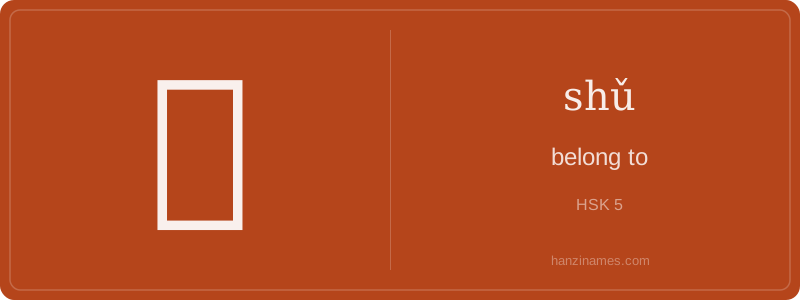
In daily life, 属 is most famously used in the Chinese zodiac: people say 我属狗 (Wǒ shǔ gǒu, 'I belong to the Dog') to state their birth-year animal. This usage dates back over 2,000 years to Han Dynasty records linking animals to the 12-year cycle. It also appears in legal and administrative language — e.g., 本校属教育部管辖 (This school falls under the jurisdiction of the Ministry of Education), a phrase found in official documents since the 1950s.
The character’s form combines 尸 (a radical meaning 'corpse' or 'person at rest', historically used for 'body-related' or 'position-related' meanings) and 羽 (yǔ, 'feathers'), but this is misleading: 羽 was originally a phonetic component, not semantic. The earliest seal script form (c. 3rd c. BCE) shows 尸 + 有序的线条 suggesting 'subordination'. So 属 fundamentally expresses hierarchical categorization — not feathers or corpses!
Hi students! The character 属 (shǔ) is a very useful and common word in modern Chinese. At its core, it means 'to belong to' or 'to be categorized under' — think of it like putting something into a group or class. You’ll see it often in grammar (e.g., noun classifiers), zodiac talk ('I’m a Tiger — I 属虎'), and formal writing when indicating affiliation (e.g., 'this department belongs to the university'). It’s not about physical ownership, but about classification and relationship.
Don’t confuse shǔ with zhǔ (its rare alternate reading). In everyday speech, you’ll almost always hear shǔ — especially in phrases like 属于 (shǔyú, 'to belong to') or 生肖 (shēngxiào, 'zodiac sign'). The zhǔ pronunciation appears only in ancient texts or specialized contexts like classical poetry, so beginners can safely focus on shǔ for now.
This character appears in HSK Level 5, meaning it’s more advanced — but don’t worry! Its usage is logical and highly patterned. Once you grasp the idea of ‘categorization’ or ‘affiliation’, you’ll recognize it across many compound words. Practice linking it to real-life categories: your zodiac animal, your school department, or even your nationality — all use 属 to express ‘belonging’ in a systemic, organized way.
Example Sentences
Common Compounds
Similar Characters — Don't Mix These Up
Your First Step into Chinese Culture: Get a Chinese Name
Every journey into Chinese begins with a name. Use our free Chinese name generator to create a meaningful, personalized Chinese name that fits you perfectly.
Get My Chinese Name →