屿
Character Story & Explanation
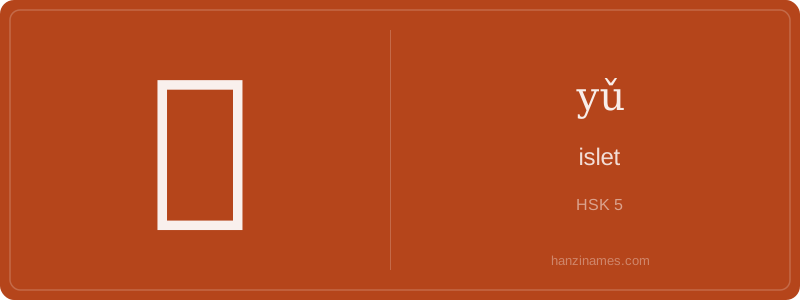
屿 appears predominantly in geographical names and literary contexts: Dongshan Yu (东山屿) in Zhejiang, Meizhou Yu (湄洲屿) — birthplace of the Mazu goddess — and countless coastal village names. It’s absent from daily conversational vocabulary but appears in official maps, tourism signage, and historical texts describing Fujian and Guangdong islands. The HSK 5 placement reflects its specialized, non-colloquial status rather than frequency.
The character is not a pictograph — no oracle bone or bronze inscription of 屿 exists. Its earliest confirmed form is in Han-era clerical script, where 山 and 与 were combined systematically. Today, Chinese learners encounter it mainly in reading about geography or classical poetry — for example, Liu Yuxi’s Tang poem referencing ‘green islets’ (青屿) amid misty rivers.
As a linguistic detective, I begin with the radical: 山 (shān), meaning 'mountain' — a clear geographic anchor. The right component, 与 (yǔ), originally a pictograph of hands holding a ritual vessel, evolved into a phonetic indicator here, lending the sound yǔ but shedding its original meaning. This is classic phono-semantic compounding: one part hints at meaning (landform), the other at pronunciation.
The character first appears in standardized form during the Han dynasty’s clerical script era, not earlier oracle bones or bronzes — no ancient pictorial 'islet' survives. Its six-stroke structure is highly efficient: three strokes for 山 (vertical, short diagonal, long diagonal), then three for 与 (dot, horizontal, curved hook). No wasted motion — every stroke serves shape or sound.
Unlike characters like 岛 (dǎo), which explicitly depicts an island with 'bird' (鸟) on 'mountain', 屿 is more poetic and literary — evoking a small, elevated landmass rising from water, often with connotations of seclusion or scenic beauty. It’s rarely used alone in speech; instead, it thrives in compound nouns and poetic place names, preserving a classical register that modern Mandarin otherwise streamlines away.
Example Sentences
Common Compounds
Similar Characters — Don't Mix These Up
Your First Step into Chinese Culture: Get a Chinese Name
Every journey into Chinese begins with a name. Use our free Chinese name generator to create a meaningful, personalized Chinese name that fits you perfectly.
Get My Chinese Name →