幅
Character Story & Explanation
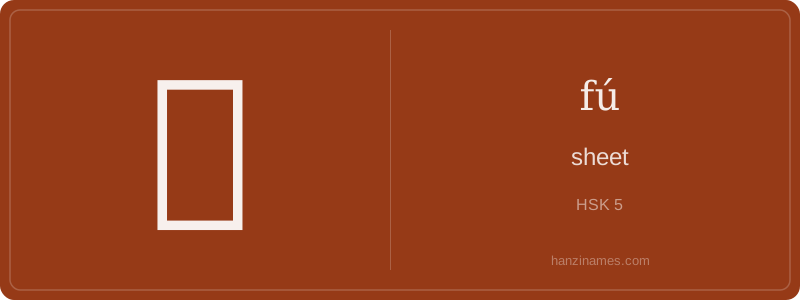
幅 is widely used in modern Chinese as a measure word for two-dimensional artworks and documents: 一幅地图 (a map), 一幅书法 (a calligraphy piece), or 一幅照片 (a photograph). It appears in official contexts too — China’s national standard GB/T 15835-2011 lists 幅 as the prescribed measure word for paintings and scrolls. You’ll also find it in idioms like 锦绣河山 (jǐnxiù héshān, ‘rivers and mountains embroidered with brocade’), where 锦 (brocade) historically came in standardized 幅-widths.
The character is a phono-semantic compound: 巾 (cloth) is the semantic radical; 畐 (fú) is the phonetic component, borrowed for sound. Archaeological evidence from Han dynasty bamboo slips confirms 幅 was already used for textile width — no oracle-bone origins, but solid Warring States–Han textual attestation in texts like the *Rites of Zhou*.
Hi students! Let’s learn 幅 (fú), a character you’ll see often when measuring or describing things with clear dimensions—especially flat, rectangular objects like paintings, maps, and cloth. It’s not used for general ‘width’ in math (that’s 宽 kuān), but specifically as a *measure word* for items that have length and width, like a scroll or a photo. Think of it as the ‘sheet unit’ — always paired with numbers and classifiers.
Notice its radical 巾 (jīn), meaning ‘towel’ or ‘cloth’ — a big clue! This tells us 幅 originally related to fabric: ancient silk or hemp textiles were measured in ‘strips’ or ‘panels’, each called a 幅. Over time, the usage expanded to any flat, framed, or bounded visual object — hence why we say 一幅画 (yī fú huà) for ‘a painting’, not *yī zhāng huà* (though both exist, 幅 is more formal/artistic).
The pronunciation fú is level-tone (first tone), so keep it steady and clear — like saying ‘foo’ but with a high, flat pitch. Don’t confuse it with 福 (fú, ‘blessing’) — same sound, different meaning and writing. Practice writing it slowly: start with the cloth radical 巾 on the left, then the right side ‘畐’ (fú), which looks like ‘one rice field + mouth’ — but remember, it’s a phonetic component, not a literal description.
Example Sentences
Common Compounds
Similar Characters — Don't Mix These Up
Your First Step into Chinese Culture: Get a Chinese Name
Every journey into Chinese begins with a name. Use our free Chinese name generator to create a meaningful, personalized Chinese name that fits you perfectly.
Get My Chinese Name →