幼
Character Story & Explanation
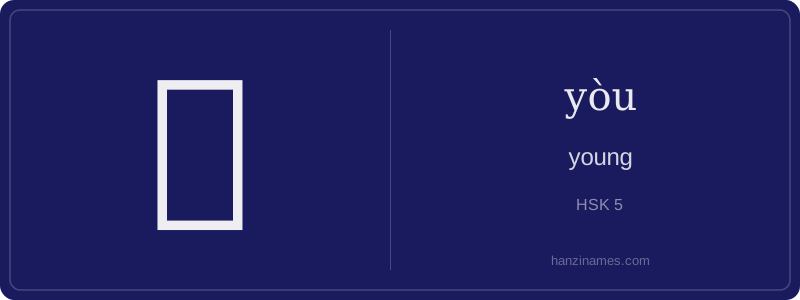
In daily life, 幼 most commonly appears in formal or institutional contexts — especially in compound words like 幼儿园 (yòu'éryuán, 'kindergarten'), 幼师 (yòushī, 'early childhood teacher'), and 幼升小 (yòu shēng xiǎo, 'transition from kindergarten to primary school'). It rarely stands alone in speech but is indispensable in education, healthcare, and policy documents concerning children under six. A key idiom is 年幼无知 (nián yòu wú zhī, 'too young to know better'), often used in legal or moral contexts to describe diminished culpability.
The character’s form dates to seal script (c. 3rd century BCE), where it combined 幺 (a tiny thread, symbolizing smallness) with 夊 (suī, a variant of 攵, indicating movement/action) — not a pictograph, but a semantic-phonetic compound. Its modern shape preserves that ancient logic: five strokes, all minimal and precise, embodying concision and care.
Imagine a sun-dappled courtyard in Beijing’s Hutong district, where a grandmother kneels beside her three-year-old grandson, gently guiding his tiny fingers as he traces the character 幼 on rice paper. Her voice is soft: 'Yòu — like a little sprout just pushing through the soil.' The character’s delicate strokes mirror the fragility and promise of early childhood — not merely 'young' as an age, but as a state of tender potential, deeply revered in Confucian-influenced family life.
This reverence extends beyond family: in Shanghai kindergartens, teachers post posters with 幼儿园 (yòu'éryuán) — 'preschool' — where children learn songs about 'little buds growing strong.' The radical 幺 (yāo), meaning 'tiny thread,' visually anchors the character in smallness and continuity, reflecting how Chinese culture views youth not as incompleteness, but as the essential, inseparable first strand of human development.
Even in modern policy, 幼 carries weight: China’s '3–6 Year Old Children Learning & Development Guidelines' (教育部, 2012) repeatedly uses 幼儿 (yòu'ér, 'young child') to denote legally recognized developmental stages. The character appears on official documents, health check forms, and parenting apps — always signaling care, protection, and societal responsibility toward those who are literally 'the smallest ones.'
Example Sentences
Common Compounds
Similar Characters — Don't Mix These Up
Your First Step into Chinese Culture: Get a Chinese Name
Every journey into Chinese begins with a name. Use our free Chinese name generator to create a meaningful, personalized Chinese name that fits you perfectly.
Get My Chinese Name →