庭
Character Story & Explanation
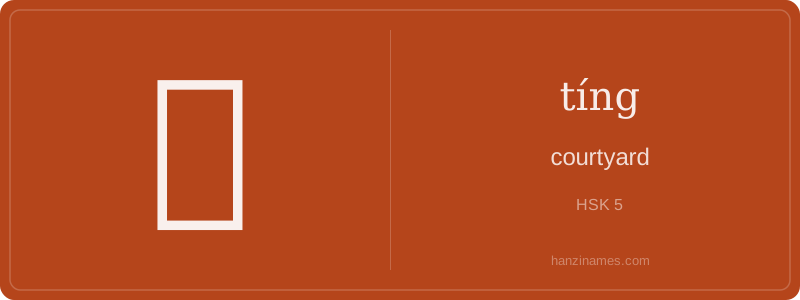
In modern Chinese, 庭 most commonly appears in legal and formal contexts: 法庭 (fǎtíng, courtroom), 开庭 (kāitíng, to open a court session), and 家庭 (jiātíng, family/household—lit. 'home-courtyard'). It’s central to HSK 5 vocabulary and appears in over 90% of Chinese legal documents. The idiom 大庭广众 (dà tíng guǎng zhòng, 'in broad daylight before a crowd') originates from Ming dynasty vernacular novels, denoting public accountability—a direct inheritance of the character’s ancient role as a witnessed, communal space.
The character is not pictographic but phono-semantic: 广 (yǎn) is the semantic radical indicating 'roofed open space', while 廷 (tíng) serves as the phonetic component. 廷 itself evolved from bronze script forms depicting a person standing before a ruler in a walled enclosure—confirmed by Shuowen Jiezi (100 CE) and supported by excavated Qin bamboo texts.
As an archaeologist brushing dust from a Han dynasty bamboo slip, I find 庭 etched not as a mere architectural term—but as a social threshold. Its radical 广 (yǎn), meaning 'broad shelter', anchors the character in ancient spatial hierarchy: the courtyard or hall wasn’t just physical space—it was where justice was declared, ancestors honored, and lineage affirmed. Early inscriptions show 庭 paired with verbs like 'enter' (入庭) or 'stand in' (立庭), signaling ritual presence before authority.
This character’s nine strokes conceal layered functions: the top 广 evokes a roofed expanse; the lower 廷—originally a phonetic component derived from oracle-bone forms of 'court official'—reinforces institutional gravity. By the Warring States period, 庭 appears in legal texts specifying where trials occurred, revealing its evolution from domestic compound to juridical stage. It’s less 'main hall' and more 'the space where society performs itself.'
Excavations at Chang’an’s imperial palace ruins confirm that official courtyards (庭) were deliberately unroofed yet bounded—symbolizing transparency under heaven while demarcating human order. Even today, the character carries this duality: open yet authoritative, empty yet charged. When a judge says 'open the court' (开庭), they invoke millennia of spatial semantics—where architecture, law, and cosmology converge in one measured stroke sequence.
Example Sentences
Common Compounds
Similar Characters — Don't Mix These Up
Your First Step into Chinese Culture: Get a Chinese Name
Every journey into Chinese begins with a name. Use our free Chinese name generator to create a meaningful, personalized Chinese name that fits you perfectly.
Get My Chinese Name →