期
Character Story & Explanation
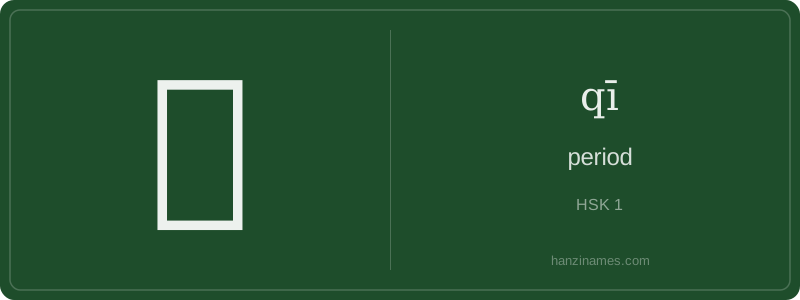
In China, 期 appears ubiquitously: students check their 期末考试 (qīmò kǎoshì, final exam) dates; renters sign a 租期 (zūqī, lease term); and supermarkets label milk with 保质期 (bǎozhìqī, shelf life). The phrase 不定期 (bùdìngqī, 'irregular/unscheduled') is common in work notices, while 成长期 (chéngzhǎngqī, 'growth period') appears in child development guides. Historically, 期 was used in Tang-dynasty administrative documents to denote official service terms and tax collection cycles.
The character’s written form evolved from seal script, where the left side 月 (originally 肉, 'flesh', later standardized as 月) served as a semantic indicator for body-related or cyclical concepts, and the right side 其 (qí) acted phonetically. No oracle-bone form survives, but by the Warring States period, 期 consistently meant 'appointed time' or 'fixed duration' — matching its modern usage.
The character 期 (qī) evokes the rhythm of time in everyday Chinese life — from school semesters to loan repayments. Its radical 月 (moon) hints at lunar cycles, historically used to mark months and deadlines. Though pronounced qī, it’s not related to ‘qi’ (energy); instead, it anchors concepts like duration, expectation, and scheduled moments — making it essential for planning, contracts, and academic life in China.
At its core, 期 represents a bounded stretch of time: not eternity, but a defined interval with a start and end. You’ll see it on university calendars (学期), bank statements (到期), and even food packaging (保质期). Its consistency across contexts reflects how deeply Chinese culture values timeliness, accountability, and cyclical structure — all wrapped in one 12-stroke character.
Despite its HSK Level 1 status, 期 carries nuanced weight: it implies commitment (as in 约期 — 'to agree on a date') and consequence (e.g., 过期 — 'expired'). Unlike vague terms like 时候 (shíhou, 'time'), 期 conveys precision and formality. Mastering it unlocks clarity in schedules, legal language, and daily logistics — a quiet but indispensable pillar of modern Mandarin communication.
Example Sentences
Common Compounds
Similar Characters — Don't Mix These Up
Your First Step into Chinese Culture: Get a Chinese Name
Every journey into Chinese begins with a name. Use our free Chinese name generator to create a meaningful, personalized Chinese name that fits you perfectly.
Get My Chinese Name →