迫
Character Story & Explanation
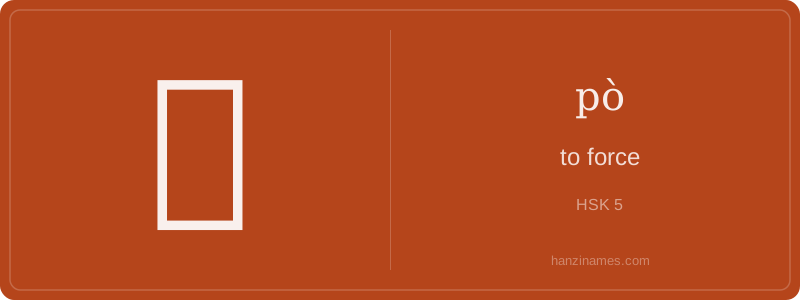
In contemporary China, 迫 is widely used in official discourse and media to describe urgent societal pressures — such as 迫切需要 (urgent need) in public health campaigns or 迫于形势 (forced by circumstances) in economic reporting. It appears in six of the top 500 most frequent terms in the People’s Daily corpus (2015–2023), especially in phrases like 迫使 (to compel) and 迫害 (to persecute), the latter historically documented in legal and human rights contexts including the 1996 Criminal Law revision.
The character’s form is not pictographic but phono-semantic: the left component 白 (bái) originally served as a phonetic hint (though pronunciation diverged), while 辶 signals motion-related meaning. No oracle-bone or bronze script forms survive; earliest attestation is in Warring States bamboo texts (c. 4th century BCE), where it consistently meant ‘to press upon’ or ‘to pursue closely’. Today, Chinese learners encounter it first in HSK 5 vocabulary like 迫不及待 (can’t wait) — a fixed idiom where 迫 functions as part of an inseparable lexical unit.
The character 迫 (pò) conveys urgency and compulsion — not gentle persuasion, but pressure that leaves little room for refusal. Its radical 辶 (chuò), the 'walking' or 'movement' radical, suggests action in motion — a force pushing forward, often against resistance. This visual structure mirrors its meaning: an external pressure driving someone toward a decision or action, like deadlines tightening or authorities demanding compliance.
In modern Chinese, 迫 appears frequently in formal and high-stakes contexts: legal documents, news reports on crises, and policy announcements. It rarely stands alone; instead, it pairs with other characters to form compound words expressing constraint, immediacy, or coercion — such as 迫切 (urgent) or 迫害 (persecution). Its tone is serious, even grave, signaling gravity rather than casual influence.
Unlike softer synonyms like ‘encourage’ (鼓励) or ‘request’ (请求), 迫 implies imbalance of power or circumstance. A student may feel 迫于无奈 (forced by helplessness) to take a job outside their field; a city may face 迫在眉睫的洪水威胁 (an imminent flood threat). The character carries cultural weight — reflecting Confucian awareness of social pressure, yet also modern realities of rapid development, regulation, and collective responsibility.
Example Sentences
Common Compounds
Similar Characters — Don't Mix These Up
Your First Step into Chinese Culture: Get a Chinese Name
Every journey into Chinese begins with a name. Use our free Chinese name generator to create a meaningful, personalized Chinese name that fits you perfectly.
Get My Chinese Name →