征
Character Story & Explanation
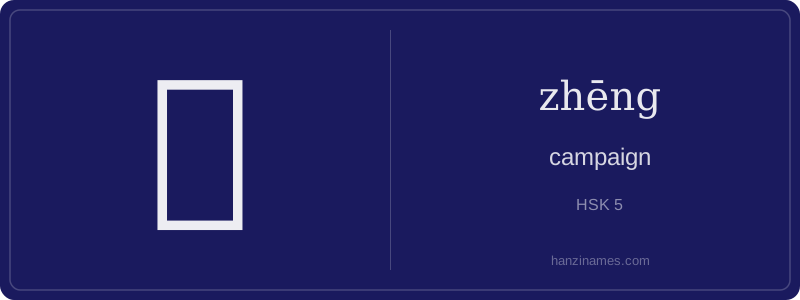
Historically, 征 appears in classical texts like the Book of Rites (Lǐjì) and Confucian commentaries to denote ‘punitive expeditions’ — state-authorized military campaigns against rebellious states, distinguishing them from unjust aggression (伐). Today, it’s widely used in official and formal contexts: government agencies conduct 全国人口普查 (national census), where citizens are asked to 'cooperate with data collection' (配合数据征集). It also appears in modern terms like 征婚 (zhēng hūn, 'seeking marriage partners') — reflecting active, intentional pursuit.
The character evolved from seal script, where 彳 + 正 clearly represented 'marching forth under legitimate authority'. While not a pictograph, its structure reflects Warring States-era bureaucratic language — emphasizing sanctioned movement. In daily life, Chinese speakers most commonly encounter it in signs like '招聘启事' (job postings) or '问卷征集' (survey collection notices).
Hi students! Let’s explore 征 (zhēng), an HSK Level 5 character with 8 strokes and the ‘walking’ radical 彳 on the left. Though its basic dictionary meaning is often listed as 'journey', that’s only part of the story — in modern Chinese, 征 almost always appears in contexts of *active movement toward a goal*: conquering territory, recruiting people, or collecting data. It carries energy, purpose, and sometimes authority — never a casual stroll!
Notice how the left side 彳 (chì) signals motion — it’s the same radical in characters like 往 (wǎng, 'to go') and 徒 (tú, 'on foot'). The right side 正 (zhèng) means 'upright' or 'correct', suggesting movement aligned with principle or duty. So 征 isn’t just any journey — it’s a *righteous march*, a mission-driven advance. This nuance explains why it appears in words like 'military campaign' and 'survey'.
Don’t confuse 征 with similar-sounding characters like 正 (zhèng, 'correct') or 证 (zhèng, 'evidence'). Its tone (first tone: zhēng) and radical make it distinct. As you practice writing, remember the stroke order: start with the left radical 彳 (3 strokes), then write 正 (5 strokes) — top to bottom, left to right. Use flashcards with real phrases like 征服 (conquer) or 招征 (recruit) to build natural intuition.
Example Sentences
Common Compounds
Similar Characters — Don't Mix These Up
Your First Step into Chinese Culture: Get a Chinese Name
Every journey into Chinese begins with a name. Use our free Chinese name generator to create a meaningful, personalized Chinese name that fits you perfectly.
Get My Chinese Name →