恶
Character Story & Explanation
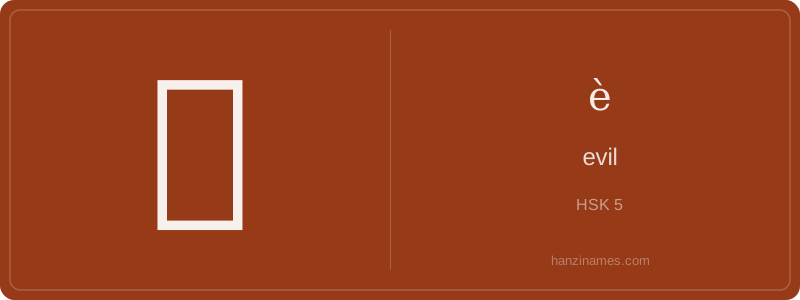
恶 appears frequently in modern Chinese media, law, and ethics discourse—for example, in news headlines like ‘严惩违法犯罪’ (yán chéng wéi fǎ xiōng è, 'strictly punish illegal and evil acts'), where it pairs with 犯罪 (crime). It’s central in classical texts like the *Mencius*, which debates whether human nature is inherently good (性善) or contains potential for 恶. The idiom 好恶分明 (hào wù fēnmíng, 'clear distinction between likes and dislikes') uses wù to express moral discernment—not mere preference, but ethical judgment.
The character evolved from seal script (c. 3rd c. BCE), where 亚 represented a ritual vessel base and 心 emphasized emotional/moral response. By Han dynasty bamboo slips, 恶 standardized as a semantic-phonetic compound: 亚 hints at pronunciation (archaic *ŋˤraʔ), while 心 signals meaning domain. No oracle-bone form survives—its earliest attested use is in Warring States manuscripts discussing moral cultivation.
Hello students! Today we’ll explore the character 恶 (è), which means 'evil' or 'wicked'. It’s an HSK Level 5 character—so it’s intermediate-to-advanced, but very useful. Notice its radical is 心 (xīn), meaning 'heart'—a clue that this character relates to inner moral states, not just external actions. The top part, 亚 (yà), originally meant 'second' or 'subordinate', and here suggests something ‘beneath virtue’—a conceptual foundation for 'evil' as moral deficiency.
This character has two main pronunciations: è (most common, meaning 'evil') and wù (less frequent, meaning 'to hate'). Don’t confuse wù with the verb 憎 (zēng, also 'to hate')—they’re different characters with distinct origins and usage. In spoken Mandarin, è is far more common in compounds like 恶劣 (èliè, 'bad/dire') or 恶心 (ěxīn, 'nauseating'), where tone changes (ě) reflect colloquial adaptation.
Writing 恶 requires 10 strokes—and yes, stroke order matters! Start with the left vertical stroke of 亚, then follow standard top-to-bottom, left-to-right rules. The 心 radical at the bottom must be written last, with its three dots aligned evenly. Practice slowly: accuracy builds muscle memory. Remember—this isn’t just a symbol for 'bad'; in Chinese philosophy, 恶 reflects a deviation from harmony (和) and virtue (德), making it culturally weighty, not merely descriptive.
Example Sentences
Common Compounds
Similar Characters — Don't Mix These Up
Your First Step into Chinese Culture: Get a Chinese Name
Every journey into Chinese begins with a name. Use our free Chinese name generator to create a meaningful, personalized Chinese name that fits you perfectly.
Get My Chinese Name →