慰
Character Story & Explanation
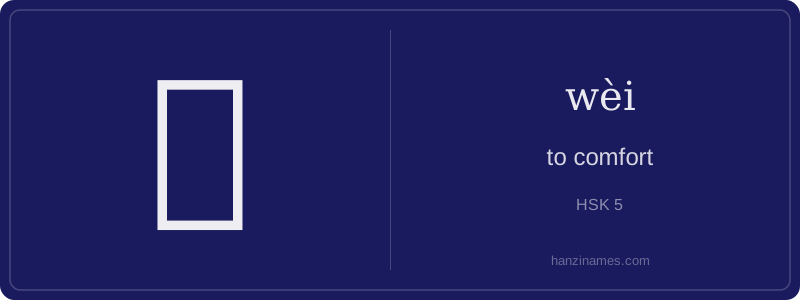
慰 is widely used in modern China in official and humanitarian contexts: provincial governments conduct 年终慰问 (niánzhōng wèiwèn, year-end consolation visits) to retirees and veterans; Red Cross teams distribute 慰问品 (wèiwèn pǐn, consolation goods) after earthquakes. A well-documented phrase is 慰问信 (wèiwèn xìn), or 'consolation letter'—standardized during the Sino-Japanese War (1937–1945) to boost troop morale. Today, it remains central to state-led social welfare communication.
The character’s form dates to seal script (c. 3rd century BCE): it combines the 心 (heart) radical with 尉 (wèi), originally a phonetic component meaning 'to pacify' or 'to quell'. 尉 itself derived from a pictograph of a hand holding a weapon—but by Han dynasty (206 BCE–220 CE), its meaning shifted toward administrative authority and calming unrest. Thus, 慰 literally evokes 'calming the heart through authoritative care'—a concept deeply aligned with traditional governance ethics.
The Chinese character 慰 (wèi) carries the core meaning 'to comfort'—but with a distinct cultural weight. Unlike English 'comfort', which can be physical (a soft chair) or emotional, 慰 is almost exclusively psychological and relational: it implies active, empathetic intervention to soothe sorrow, grief, or anxiety. It conveys intentionality and moral responsibility—comforting isn’t passive sympathy but a deliberate act of care rooted in Confucian ideals of benevolence (仁, rén) and mutual obligation.
Western equivalents like 'console', 'soothe', or 'reassure' often emphasize verbal or ritual gestures (e.g., saying 'it’ll be okay'). In contrast, 慰 frequently appears in formal, collective, or institutional contexts—such as government慰问 (wèiwèn) visits to disaster victims or military families—highlighting duty, dignity, and social harmony over individual catharsis. This reflects a collectivist ethos where emotional relief is embedded in social recognition and material support.
Moreover, 慰 rarely stands alone in speech; it’s nearly always bound in compounds (e.g., 安慰, 慰问, 慰藉). Its standalone use is literary or archaic, appearing in classical poetry or formal speeches. This contrasts sharply with English, where 'comfort' functions freely as noun and verb. The 心 (heart/mind) radical reinforces its internal, affective domain—signaling that true 慰 arises not from external fixes, but from resonant human connection grounded in sincerity and respect.
Example Sentences
Common Compounds
Similar Characters — Don't Mix These Up
Your First Step into Chinese Culture: Get a Chinese Name
Every journey into Chinese begins with a name. Use our free Chinese name generator to create a meaningful, personalized Chinese name that fits you perfectly.
Get My Chinese Name →