戒
Character Story & Explanation
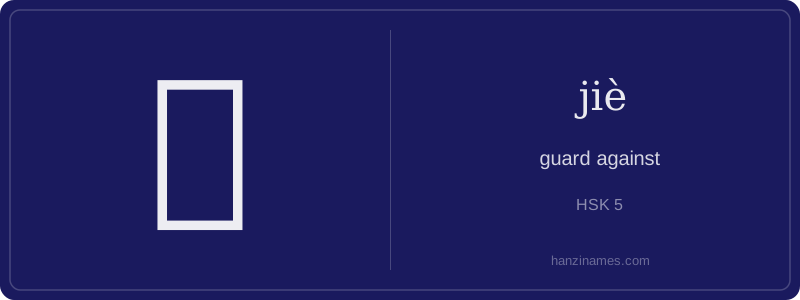
In daily Chinese, 戒 most commonly appears in health and self-improvement contexts: 戒烟 (jiè yān, 'quit smoking'), 戒酒 (jiè jiǔ, 'abstain from alcohol'), and 戒手机 (jiè shǒujī, 'reduce smartphone use')—all documented in public health campaigns since the 2000s. It’s central to Buddhist terminology like 戒律 (jièlǜ, 'monastic precepts'), appearing in canonical texts such as the Dharmaguptaka Vinaya, translated into Chinese as early as the 3rd century CE.
The character’s earliest verified form appears in Warring States bamboo manuscripts (c. 475–221 BCE), where it depicts a hand () grasping a halberd (戈)—a clear pictographic origin signifying 'to stand guard'. No oracle bone inscriptions of 戒 survive, but its consistent structure across excavated texts confirms its function as a verb of deliberate restraint, not mere prohibition.
As an archaeologist brushing dust from a Han dynasty bamboo slip, I find 戒 etched not as a weapon—but as a warning. Its bronze script ancestors show a hand holding a halberd (戈), yet the meaning evolved from military vigilance to moral restraint. This shift mirrors Confucian texts where 戒 appears in admonitions against desire—like the Analects’ ‘three things to guard against’ at different life stages. The character’s austerity belies its deep ethical weight: it is less about prohibition and more about mindful self-governance.
Excavating further, I note how 戒 resists simplification—it retains its original structure across millennia, unlike many characters altered for speed. Its seven strokes form a compact, upright shape: two horizontal lines (representing boundaries), a vertical pillar (integrity), and the戈 radical anchoring it in duty. Even in Tang steles, scribes preserved this balance—suggesting that ‘guarding against’ was never casual, but ritualized discipline. The stroke order itself enacts caution: start with the boundary (top horizontal), then descend with control.
Modern linguistics confirms what the artifacts whisper: 戒 carries an imperative tone—not ‘don’t’, but ‘be vigilant’. It appears in legal codes (e.g., Tang Code’s 戒律), monastic vows (Buddhist precepts), and medical texts advising physicians to 戒 anger or excess. Unlike passive verbs, 戒 demands active, continuous attention—like a sentinel scanning the horizon. Its enduring presence in HSK 5 reflects how deeply Chinese thought links ethics with alertness: to know something is dangerous is only half the act; to *guard against* it is the full human responsibility.
Example Sentences
Common Compounds
Similar Characters — Don't Mix These Up
Your First Step into Chinese Culture: Get a Chinese Name
Every journey into Chinese begins with a name. Use our free Chinese name generator to create a meaningful, personalized Chinese name that fits you perfectly.
Get My Chinese Name →