承
Character Story & Explanation
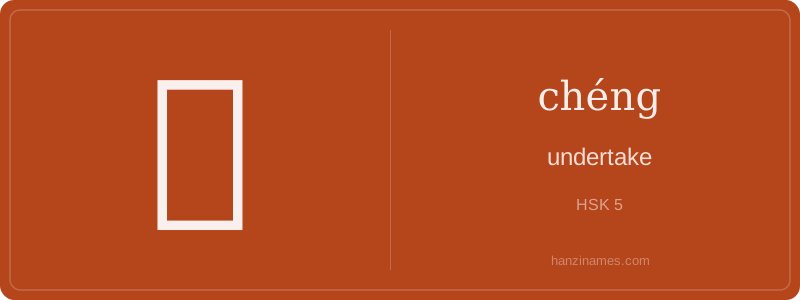
In modern Chinese, 承 is rarely used alone but thrives in formal, written contexts: official documents (e.g., 承诺 ‘commitment’), academic acknowledgments (承蒙指导 ‘grateful for your guidance’), and idioms like 承前启后 (‘inherit the past and usher in the future’). It appears in legal contracts (‘Party A hereby undertakes…’), university honorifics (承蒙厚爱), and classical allusions in state media. Its high-register tone makes it nearly absent in casual speech — you’ll hear it in news broadcasts, not café banter.
The character’s seal-script form clearly shows two hands () beneath a horizontal line (一), representing something being received or supported — likely a ceremonial vessel or mandate. This pictorial logic remains legible in the modern form: the top component (了 + 一) echoes the ‘object received’, while the bottom 扌 (hand radical) anchors its action-oriented meaning.
Our detective begins in the Shāng dynasty oracle bones and Zhōu bronze inscriptions — but here’s the twist: 承 does not appear in authenticated oracle bone script. Its earliest secure attestation is in Warring States bamboo texts and the *Shuōwén Jiězì* (121 CE), where Xu Shen classifies it under the 手 (hand) radical and defines it as ‘to receive with both hands’ — a gesture of reverence and acceptance. The structure suggests two hands ( + 一, later stylized) supporting something above, reinforcing its core semantic field of bearing, inheriting, and undertaking.
Over centuries, 承 evolved from a concrete physical act — lifting an offering or receiving a mandate — into abstract institutional and moral concepts. By the Hàn dynasty, it denoted ‘succession’ in imperial legitimacy (e.g., 承天, ‘receiving Heaven’s mandate’), and in Confucian texts, it carried ethical weight: to uphold tradition, fulfill duty, or shoulder responsibility. This semantic expansion reflects how early Chinese political philosophy encoded ritual posture into lexical meaning.
The claim that 承 refers to ‘Cheng, third of the legendary Flame Emperors descended from Shennong’ appears in late imperial encyclopedias like the *Gǔjīn Túshū Jíchéng*, but no pre-Táng historical source names a Flame Emperor ‘Cheng’. Rather, 承’s association with Shennong is indirect: Shennong ‘bore’ (承) agricultural civilization, and later emperors claimed to ‘continue’ (承) his legacy. Thus, 承 functions less as a proper name and more as a dynastic verb — a linguistic vessel for continuity itself.
Example Sentences
Common Compounds
Similar Characters — Don't Mix These Up
Your First Step into Chinese Culture: Get a Chinese Name
Every journey into Chinese begins with a name. Use our free Chinese name generator to create a meaningful, personalized Chinese name that fits you perfectly.
Get My Chinese Name →