拆
Character Story & Explanation
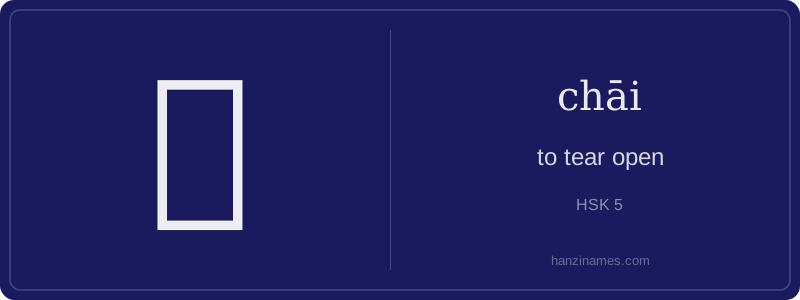
In contemporary Chinese life, 拆 most commonly appears in urban development contexts—‘拆迁’ (chāi qiān, ‘demolition and relocation’) is a widely documented term in official policy documents, news reports, and academic studies on China’s rapid urbanization since the 1990s. It also features in everyday logistics: ‘拆快递’ (chāi kuài dì, ‘to open a delivery package’) is ubiquitous on e-commerce platforms like Taobao and in spoken Mandarin. A well-known idiom is ‘拆东墙补西墙’ (chāi dōng qiáng bǔ xī qiáng, ‘tear down the east wall to patch the west wall’), meaning short-term, unsustainable problem-solving—attested in Ming dynasty vernacular fiction and still used in financial reporting.
The character’s earliest attested form appears in clerical script (lìshū) of the Han dynasty (206 BCE–220 CE), where 扌 + 戊 evolved into the modern 扌 + 厄 + 刂 structure. Though no oracle bone or bronze inscription of 拆 survives, its component 刂 confirms its association with cutting tools, while the hand radical emphasizes manual execution—reflecting real-world practices like opening sealed bamboo slips or dismantling wooden construction joints in ancient architecture.
As an archaeologist brushing dust from a Han dynasty bamboo slip, I find 拆 etched with crisp, deliberate strokes—its 扌 (hand) radical anchoring it in human action. This isn’t passive observation; it’s the hand *initiating rupture*: tearing open a sealed document, dismantling a structure, or unraveling a binding. The right side, 刂 (knife radical), appears in later seal script forms—not as a literal blade, but as a marker of incision, precision, and irreversible change. Its eight strokes encode intentionality: not destruction, but purposeful separation.
Excavating Tang-era administrative records reveals 拆 used in fiscal contexts: ‘拆封’ (chāi fēng) meant breaking the wax seal on tax registers before audit—a ritual of accountability. In Song dynasty legal texts, 拆 appears in property disputes, denoting the physical division of ancestral estates. The character never meant ‘destroy’; rather, it signified *authorized deconstruction*—a controlled, documented undoing, often tied to governance, inheritance, or verification.
Modern excavations of 20th-century factory ledgers show 拆 repurposed for industrial planning: ‘拆装’ (chāi zhuāng) logged machinery disassembly for maintenance. Even today, its semantic core remains intact—action directed at *opening what was closed*, whether a package, a contract, or a building. Unlike 破 (pò, ‘to break’—accidental or violent) or 毁 (huǐ, ‘to ruin’—total loss), 拆 implies agency, reversibility, and functional intent. It is archaeology in verb form: the careful, methodical uncovering of what lies within.
Example Sentences
Common Compounds
Similar Characters — Don't Mix These Up
Your First Step into Chinese Culture: Get a Chinese Name
Every journey into Chinese begins with a name. Use our free Chinese name generator to create a meaningful, personalized Chinese name that fits you perfectly.
Get My Chinese Name →