拐
Character Story & Explanation
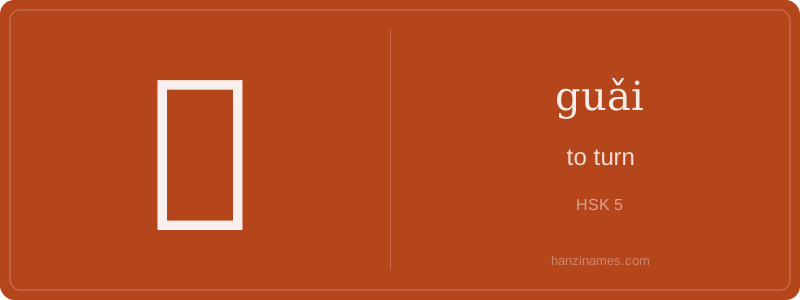
In modern Mandarin, 拐 most commonly appears in directional instructions (e.g., 拐弯 'to turn a corner') and in compound verbs like 拐骗 ('to abduct and deceive'), a serious crime under China’s Criminal Law (Article 240). It features in the idiom 拐弯抹角, meaning 'to speak evasively', reflecting cultural value placed on indirect communication to maintain harmony. The term is widely used in urban navigation apps and traffic signage across mainland China.
The character’s form evolved from seal script, where it depicted a hand (扌) guiding or deflecting a bent line—symbolizing redirection. Though not a pictograph of a literal object, its structure consistently emphasized manual intervention in changing course, documented in authoritative sources like the *Shuōwén Jiězì* (100 CE) as 'a hand causing deviation'.
The character 拐 (guǎi) embodies a subtle yet profound aspect of the Chinese worldview: change as an intentional, embodied act—not abrupt rupture, but a deliberate shift in direction. Its hand radical (扌) signals agency; turning isn’t passive fate, but a choice made with the body and will. This reflects Confucian and Daoist sensibilities where harmony arises not from rigidity, but from responsive, mindful redirection—like a river bending around stone rather than breaking against it.
In Chinese spatial thinking, ‘turning’ is rarely abstract—it’s rooted in movement through real places: alleyways (胡同), street corners, mountain paths. 拐 thus carries geographic intimacy: to turn is to navigate complexity, negotiate boundaries, and honor relational space. Even in speech, ‘turning’ a phrase (拐弯抹角) implies tactful indirection—a cultural preference for preserving face over blunt linear truth.
Historically, 拐 also acquired moral weight: to ‘turn’ someone astray (拐骗) is among the gravest social violations, revealing how deeply ethics are tied to orientation—toward virtue (正道) or away from it. Thus, 拐 encapsulates a dynamic moral cartography: every turn is both physical navigation and ethical alignment, mirroring the classical ideal of the junzi (gentleman) who adjusts course with wisdom, not convenience.
Example Sentences
Common Compounds
Similar Characters — Don't Mix These Up
Your First Step into Chinese Culture: Get a Chinese Name
Every journey into Chinese begins with a name. Use our free Chinese name generator to create a meaningful, personalized Chinese name that fits you perfectly.
Get My Chinese Name →