拼
Character Story & Explanation
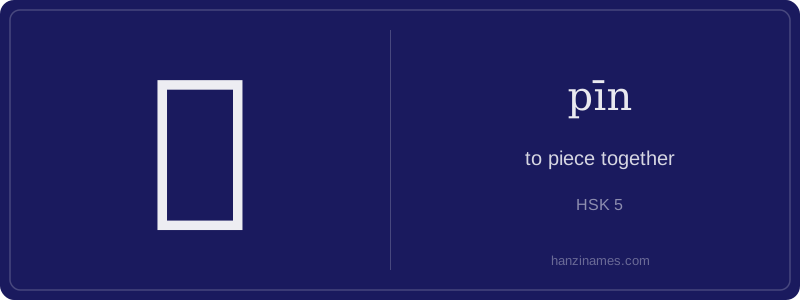
In contemporary Chinese, 拼 most commonly appears in pīnyīn (the Romanization system), where users 'piece together' phonetic components—initials, finals, and tones—to input characters on keyboards or phones. It’s central to education: HSK Level 5 learners master 拼音 (pīnyīn) as the foundational tool for literacy. The term 拼写 (pīnxiě, 'spelling') is used daily in schools and exams, and idioms like 拼死拼活 (pīn sǐ pīn huó, 'to work oneself to exhaustion') reflect its extension into intense effort.
The character’s form is not pictographic but phono-semantic: 扌 (hand radical) signals action; the phonetic component 並 (bìng, 'side-by-side') suggests simultaneity and coordination—not visual resemblance, but conceptual pairing. No oracle bone or bronze script forms survive for 拼; it first appears reliably in Han dynasty clerical script, already bearing its modern meaning of 'assembling' or 'striving.'
As an archaeologist brushing dust from a Tang-dynasty stele, I uncover 拼 not as a static glyph—but as a dynamic gesture frozen in ink: the left hand radical 扌 gripping two fragmented pieces, while the right side 並 (bìng) — meaning 'side by side' — reveals its ancient logic: coordination, alignment, synthesis. This isn’t mere assembly; it’s intentional convergence—like scholars collating bamboo slips or artisans joining lacquered panels.
Excavations of Song-era printing manuals confirm 拼’s early technical use: woodblock printers ‘pieced together’ movable type characters—a labor-intensive act requiring precision and patience. The character thus evolved from physical craft to cognitive operation: assembling sounds (pīnyīn), ideas, or efforts. Its nine strokes map a ritual of integration: three for the hand, six for the dual structure—echoing the Confucian ideal of harmonizing differences into unity.
Modern excavations of digital interfaces reveal 拼’s quiet dominance: every Chinese smartphone user ‘pieces together’ phonetic inputs to generate characters—a silent, daily reenactment of its ancient function. Even in slang like 拼爹 (pīn diē, 'to compete via family connections'), 拼 retains its core semantic gravity: marshaling disparate resources toward a goal. It is, fundamentally, the grammar of effort made visible.
Example Sentences
Common Compounds
Similar Characters — Don't Mix These Up
Your First Step into Chinese Culture: Get a Chinese Name
Every journey into Chinese begins with a name. Use our free Chinese name generator to create a meaningful, personalized Chinese name that fits you perfectly.
Get My Chinese Name →