掌
Character Story & Explanation
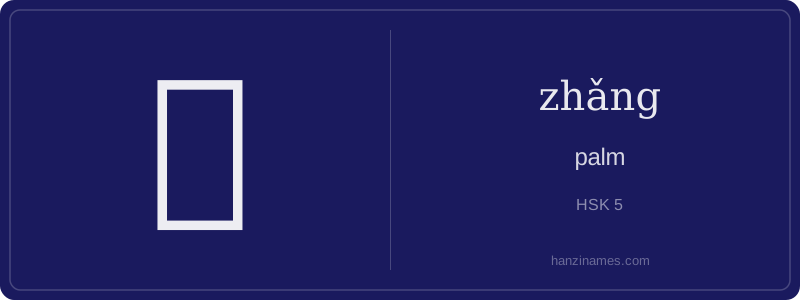
In daily life, 掌 appears most frequently in verbs like 掌握 (zhǎngwò, 'to master') and 掌权 (zhǎngquán, 'to hold power'), both HSK 5 vocabulary items. Historically, it features in classical texts such as the Mencius (3rd c. BCE), where 掌政 denotes 'administering state affairs'. A well-documented idiom is 独掌大权 (dú zhǎng dà quán, 'to monopolize supreme authority'), used in Ming-Qing historical records describing eunuch influence.
The character’s form is not a direct pictograph but a phono-semantic compound: 手 (hand) + 尚 (shàng, phonetic, suggesting zhǎng). No oracle-bone or bronze-inscription form survives, but the earliest attested version appears in Warring States bamboo slips—showing the hand radical firmly established, confirming its semantic grounding in manual action.
As an archaeologist sifting through layers of Chinese script, I trace 掌 back not to oracle bones—but to the early seal scripts of the Warring States period (475–221 BCE), where its structure reveals a hand (手 radical) cradling a small, rounded element: likely a stylized representation of the fleshy center of the palm. This was no abstract symbol—it mirrored anatomical observation, reflecting how ancient scribes perceived agency and control emanating from the palm’s surface.
The character’s evolution shows deliberate refinement: by the Han dynasty, the ‘hand’ radical stabilized on the left, while the right side crystallized into 尚—a phonetic component hinting at pronunciation (zhǎng), though originally unrelated in meaning. This phonetic loan reflects a pivotal shift: from pure pictography toward phono-semantic compounding, enabling systematic expansion of the lexicon without inventing wholly new forms.
What makes 掌 archaeologically compelling is its semantic durability. Unlike many characters that shifted meaning radically over millennia, 掌 retained its core referent—the palm—while naturally extending into metaphorical domains: ‘to掌 (zhǎng)’ means ‘to hold authority’, as if power itself rests in the open palm. This continuity suggests deep cultural anchoring: the palm wasn’t just anatomy—it was the locus of touch, gesture, oath-taking, and governance.
Example Sentences
Common Compounds
Similar Characters — Don't Mix These Up
Your First Step into Chinese Culture: Get a Chinese Name
Every journey into Chinese begins with a name. Use our free Chinese name generator to create a meaningful, personalized Chinese name that fits you perfectly.
Get My Chinese Name →