控
Character Story & Explanation
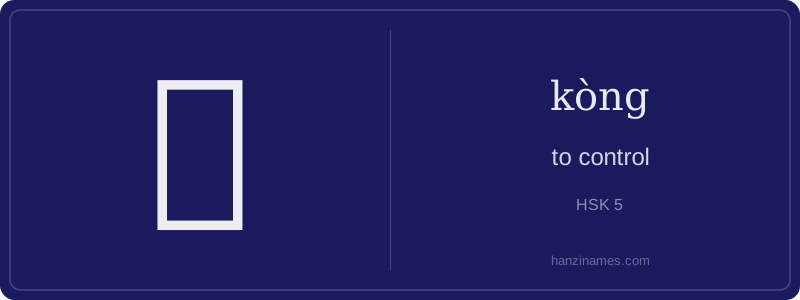
控 is deeply embedded in modern Chinese legal, technological, and social discourse. It appears in the PRC Criminal Procedure Law (Article 170) specifying prosecutors' authority to 'control arrests' (批准逮捕), and in everyday tech contexts like 控制台 (kòngzhìtái, 'control panel') on software interfaces. A common idiom is 严加控制 (yánjiā kòngzhì, 'strictly control'), widely used in public health policy (e.g., pandemic response documents). It also features in the term 自控力 (zìkònglì, 'self-control'), popularized by psychological education campaigns since 2010.
The character’s form is a documented phono-semantic compound: left radical 扌 (hand action) + right phonetic component 空 (kōng, providing sound and partial meaning—'emptiness' evoking openness to direction). No oracle-bone or bronze inscription evidence exists for 控; it first appears reliably in Han-era clerical script, confirming its later derivation as a functional administrative character.
As a detective tracing 控’s evolution, I begin at its radical: 扌 (hand), signaling physical or intentional action—this isn’t passive observation but *active manipulation*. The right side, 空 (kōng, 'empty'), originally suggested ‘directing into emptiness’—a classical metaphor for commanding space, authority, or outcomes without visible force. Early seal script (c. 3rd century BCE) shows clear hand + phonetic component, confirming its status as a phono-semantic compound—not a pictograph, but a calculated linguistic tool.
By the Han dynasty, 控 appears in historical texts like the *Shiji* (Records of the Grand Historian), used to describe imperial control over frontier regions—‘controlling Xiongnu tribes’ or ‘controlling river floods’. Here, 控 conveys authoritative restraint, not brute force. Its semantic range expanded from physical restraint (e.g., holding reins) to administrative oversight and psychological influence—foreshadowing modern usage in law, tech, and psychology.
The character’s stability across 2,000 years reveals how Chinese conceptualizes control: not domination, but calibrated agency—like a hand guiding rather than crushing. Even today, 控 rarely stands alone; it thrives in compounds where precision matters: 控制 (control), 控诉 (to accuse), 控制台 (control panel). This consistency reflects Confucian ideals of measured authority—control as responsibility, not power for its own sake.
Example Sentences
Common Compounds
Similar Characters — Don't Mix These Up
Your First Step into Chinese Culture: Get a Chinese Name
Every journey into Chinese begins with a name. Use our free Chinese name generator to create a meaningful, personalized Chinese name that fits you perfectly.
Get My Chinese Name →