捡
Character Story & Explanation
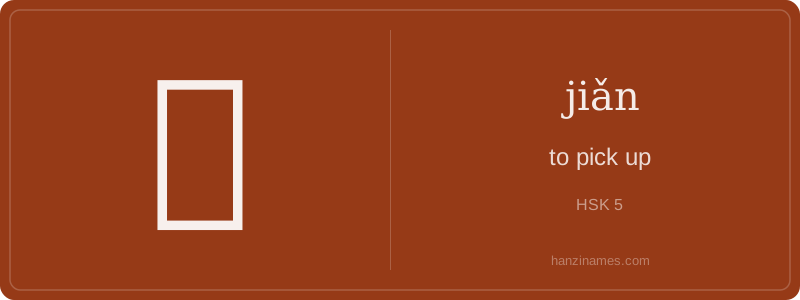
In contemporary China, 捡 is widely used in daily life—from urban clean-up initiatives like ‘捡跑’ (jiǎn pǎo, 'plogging': jogging while picking up litter) to rural practices of gathering fallen fruit or firewood. It appears in HSK 5 vocabulary lists and common phrases like 捡便宜 (jiǎn piányi, 'to get a bargain') and 捡漏 (jiǎn lòu, 'to find an undervalued antique'). Historically, 捡 was standardized in the 1956 Chinese Character Simplification Scheme; its traditional form 拣 shares the same pronunciation and core meaning but emphasizes selection more explicitly.
The character is not pictographic—it evolved from the older 拣 (with the ‘door’ radical 门 suggesting careful choice). The simplified 捡 retains 扌 (hand) + 佥 (jiǎn, originally meaning 'to consult collectively'), reflecting its semantic focus on deliberate, hands-on gathering rather than abstract selection.
In a bustling Beijing hutong at dawn, an elderly woman in a faded blue qipao bends slightly—her left hand steadying her hip, right hand reaching down with quiet purpose. She picks up a fallen persimmon from the cobblestones, brushes off dust, and places it gently in her woven bamboo basket. This simple, graceful motion embodies 捡: not snatching, but mindful collection—rooted in respect for what’s near, overlooked, or discarded.
捡 reflects a deeply embedded cultural rhythm: the act of reclaiming value from the everyday. Whether gathering fallen walnuts in rural Shaanxi orchards or retrieving a child’s dropped hairclip in a Shanghai subway station, 捡 carries no urgency—only intentionality and care. It implies agency without force, humility without loss of dignity. Unlike ‘steal’ or ‘grab’, 捡 presumes permission, context, and quiet consent from the environment.
This character’s physicality is inseparable from its meaning: the 扌 (hand) radical anchors it in human action, while the ‘佥’ (jiǎn) component historically relates to consensus and shared effort—suggesting that picking up is never truly solitary. In modern usage, 捡 appears in environmental campaigns (e.g., ‘捡垃圾’—picking up trash), reinforcing civic responsibility. Its ten-stroke form mirrors this balance: precise, economical, and grounded.
Example Sentences
Common Compounds
Similar Characters — Don't Mix These Up
Your First Step into Chinese Culture: Get a Chinese Name
Every journey into Chinese begins with a name. Use our free Chinese name generator to create a meaningful, personalized Chinese name that fits you perfectly.
Get My Chinese Name →