击
Character Story & Explanation
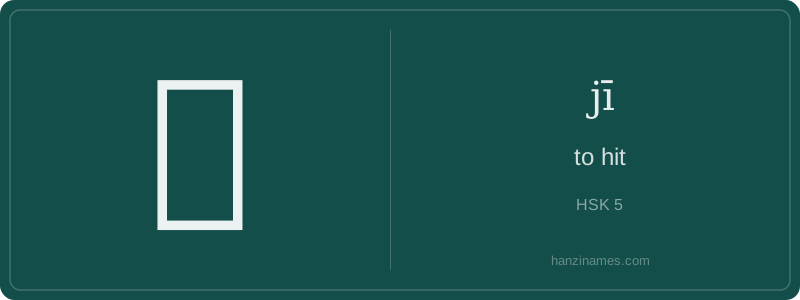
击 is ubiquitous in modern Chinese media and formal writing — especially in news headlines (e.g., ‘我军成功击落敌机’), martial arts terminology (击剑 ‘fencing’), and tech contexts (点击 ‘click’). It appears in six HSK 5+ idioms, including 百发百中 (‘100% accuracy’) and 雷厉风行 (where 击 underlies the ‘striking’ force of decisive action). Historically, it was central to military manuals like Sun Tzu’s *Art of War*, where 击 consistently denotes *initiated, targeted action*, not random violence.
The character’s earliest attested form (Qin bamboo slips, c. 3rd century BCE) shows a hand-like stroke descending into a U-shaped base — not a pictograph of hitting, but a schematic representation of directed force meeting resistance. No oracle bone version exists; scholars agree it’s a Warring States-era innovation reflecting evolving warfare tactics and bureaucratic record-keeping needs.
As a linguistic detective, I begin with the oracle bone and bronze inscriptions — but here’s the twist: 击 doesn’t appear in earliest Shang oracle bones. Its earliest confirmed form emerges in Warring States bamboo texts and Qin dynasty seal script, already stylized as a hand (又) striking downward into a concave shape (凵). The radical 凵 — not a ‘container’ here, but a *receptive surface* — suggests impact onto something open or yielding, like a drumhead or battlefield ground.
The five-stroke simplicity belies its semantic weight. Unlike pictographic characters (e.g., 日 for sun), 击 is phono-semantic: the top part (, a variant of 手/‘hand’) implies action, while 凵 grounds it spatially. By Han times, it was standard for military verbs — ‘to strike an enemy formation’ — and appears frequently in the *Records of the Grand Historian*, always paired with strategic intent, never mere physical contact.
Crucially, 击 evolved *away* from brute force toward precision and initiation: ‘to launch an attack’, ‘to trigger a response’, ‘to strike a deal’. This semantic expansion explains why modern usage favors abstract domains — cybersecurity (攻击), sports (击球), even diplomacy (击掌为盟). Its minimal stroke count (5) masks deep grammatical versatility: it functions only as a verb stem, never standalone in speech, always requiring a complement (e.g., 击败, 击中, 击发).
Example Sentences
Common Compounds
Similar Characters — Don't Mix These Up
Your First Step into Chinese Culture: Get a Chinese Name
Every journey into Chinese begins with a name. Use our free Chinese name generator to create a meaningful, personalized Chinese name that fits you perfectly.
Get My Chinese Name →