挤
Character Story & Explanation
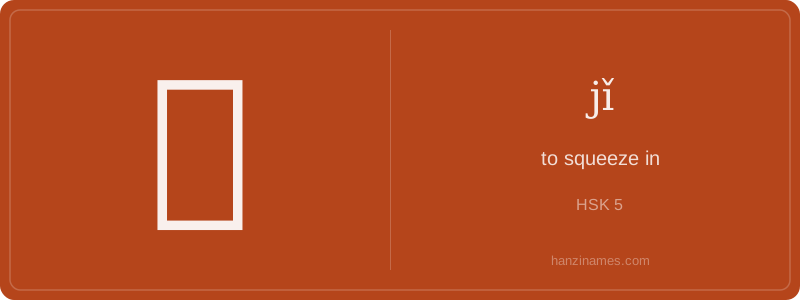
挤 is ubiquitous in modern Chinese daily life: commuters ‘squeeze into’ subway cars during rush hour (especially on Beijing Subway Line 1 or Shanghai Metro Line 2), students ‘squeeze into’ popular university courses, and vendors ‘squeeze’ stalls into narrow alleyways—documented in urban ethnographies like *Beijing: A Concise History* (2019) and CCTV’s documentary series *Urban Pulse*. Common phrases include 挤公交 (jǐ gōngjiāo, 'to squeeze onto a bus') and 挤牙膏 (jǐ yágāo, 'to squeeze toothpaste'—idiomatically meaning 'to reluctantly disclose information').
The character’s form dates to the seal script (c. 3rd century BCE), where 扌 (hand) + 齊 (qí, originally depicting evenly aligned grains or banners, later meaning 'equal' or 'in order') conveyed controlled, coordinated pressure—not violent force. This reflects its semantic core: regulated, collective effort within limits, not brute force.
The character 挤 (jǐ) embodies a deeply resonant social reality in Chinese life: the physical and psychological experience of constrained space amid density. With its hand radical 扌, it signals human agency—people actively pressing, squeezing, or maneuvering into limited room. This reflects a worldview where harmony coexists with necessity; crowding isn’t merely inconvenience—it’s a shared condition requiring mutual accommodation, patience, and subtle negotiation of personal boundaries.
In traditional Chinese urban planning and communal living—from courtyard homes (siheyuan) to crowded 20th-century danwei compounds—space was never assumed as private or abundant. 挤 thus carries no inherent negativity; rather, it conveys resilience and adaptability. To ‘squeeze in’ is to participate, to belong, to persist—not to invade. This nuance reveals how language encodes cultural tolerance for collective pressure as part of social fabric.
Modern usage extends this idea metaphorically: 挤 into a job market, 挤出 time, or 挤占 resources all retain the core sense of exerting effort within scarcity. Unlike English ‘crowd’, which often implies chaos, 挤 suggests purposeful, even dignified, compression—like bamboo bending under weight but not breaking. It mirrors Confucian ideals of yielding without surrendering, making space while holding one’s place.
Example Sentences
Common Compounds
Similar Characters — Don't Mix These Up
Your First Step into Chinese Culture: Get a Chinese Name
Every journey into Chinese begins with a name. Use our free Chinese name generator to create a meaningful, personalized Chinese name that fits you perfectly.
Get My Chinese Name →