拦
Character Story & Explanation
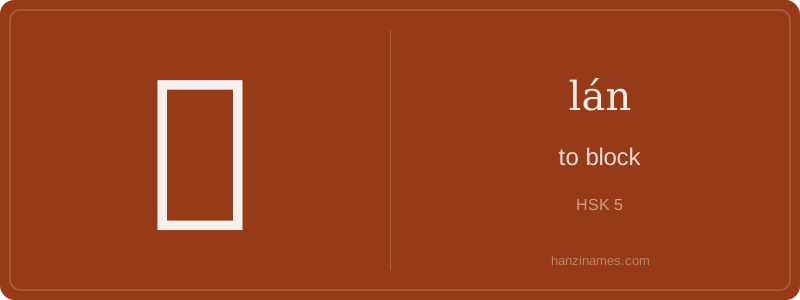
In daily life, 拦 is widely used in both formal and colloquial contexts: traffic officers 拦下司机 (lán xià sījī) to check licenses; parents 拦住孩子 (lán zhù háizi) from running into streets; cybersecurity software 拦截钓鱼邮件 (lánjié diàoyú yóujiàn) blocks phishing emails. A documented idiom is 拦路虎 (lánlǎohǔ)—'road-blocking tiger'—referring to sudden, formidable obstacles, famously used in Mao Zedong’s 1935 poem describing mountain barriers during the Long March.
The character’s structure is well-documented: 扌 (hand radical) + 栏 (lán, phonetic and semantic contributor meaning 'fence/railing'). It first appears in standardized form in the Kangxi Dictionary (1716), classified under 扌, confirming its action-oriented origin. No oracle bone or bronze script forms exist—its creation reflects late imperial administrative language needs, not ancient pictography.
As an archaeologist sifting through layers of linguistic sediment, I find 拦 not etched on oracle bones but emerging clearly in late imperial texts—its form a deliberate fusion: the hand radical 扌 (shǒu) gripping the phonetic component 栏 (lán), originally meaning 'enclosure' or 'railing'. This isn’t a pictograph of obstruction, but a semantic-phonetic compound born from bureaucratic necessity—how to stop movement without violence. The hand signals agency; the railing implies boundary. Together, they encode controlled intervention.
Excavating Ming and Qing legal manuscripts reveals 拦 frequently in petitions and magistrates’ rulings—e.g., '拦轿喊冤' (lán jiào hǎn yuān), where wronged citizens physically blocked officials’ sedan chairs to demand justice. This wasn’t mere blocking—it was ritualized, sanctioned disruption. The character thus carries historical weight: not passive obstruction, but purposeful, often righteous, intercession into authority’s flow.
Modern usage preserves this moral nuance. While digital interfaces now say '拦截短信' (intercept spam SMS), the verb still implies judgment—not random filtering, but deliberate, context-aware intervention. Even traffic police use 拦 for lawful stops ('拦停车辆'), echoing its ancient role as a regulated, accountable act—not chaos, but calibrated control. Its eight strokes are a compact inscription of social contract: the hand does not strike, but halts—to listen, assess, or redirect.
Example Sentences
Common Compounds
Similar Characters — Don't Mix These Up
Your First Step into Chinese Culture: Get a Chinese Name
Every journey into Chinese begins with a name. Use our free Chinese name generator to create a meaningful, personalized Chinese name that fits you perfectly.
Get My Chinese Name →