敬
Character Story & Explanation
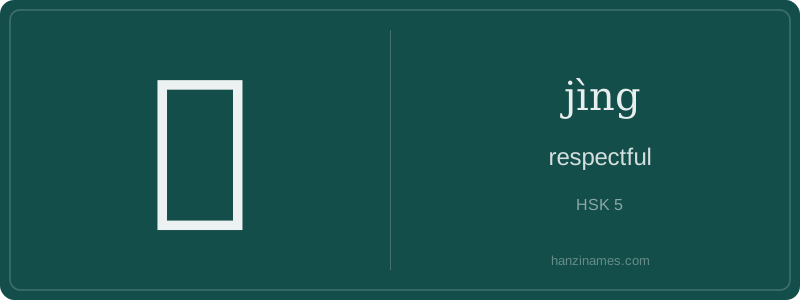
敬 is deeply embedded in Chinese social grammar: it appears in formal address (e.g., 敬爱的老师 jìng’ài de lǎoshī — 'Respected teacher'), funeral rites ('敬献花圈' jìngxiàn huāquān — 'present wreath with reverence'), and classical texts like the Analects (e.g., '居处恭,执事敬' — 'Be reverent in daily life, respectful in duties'). It’s required in official documents, academic citations, and ancestral tablets—never used casually. The idiom 恭敬不如从命 (gōngjìng bùrú cóngmìng) — 'Better to obey than merely pay lip service' — reveals its pragmatic core: respect proves itself through action, not words.
The character’s earliest attested form is in Warring States bamboo slips (475–221 BCE), where it combines a hand (手) holding a ceremonial vessel (彐) over 攴 (an early form of 攵), signifying ritual offering. No oracle-bone form exists; its origin is firmly tied to Zhou dynasty bronze ritual vocabulary—not nature imagery, but human ceremony.
Our detective begins at the Shāng dynasty oracle bones—though 敬 doesn’t appear there. Instead, it first emerges clearly in Western Zhōu bronze inscriptions (c. 1046–771 BCE) as a compound: the top half ‘gǒng’ (a hand holding a vessel) over ‘gōng’ (to offer), later stylized into ‘jīng’ (敬), with the radical 攵 (‘footstep’ or ‘action’) added to emphasize deliberate, ritualized conduct. This wasn’t just politeness—it encoded cosmological duty: honoring ancestors, heaven, and superiors to maintain cosmic harmony.
By the Hàn dynasty, 敬 became central to Confucian ethics—Mencius called it the ‘heart of reverence’ (敬之心), inseparable from rén (benevolence) and yì (righteousness). The character’s 12 strokes encode intentionality: the left side (gǒng + gōng) signifies offering; the right-side 攵 (pū) denotes active, disciplined behavior—not passive feeling, but *performed respect*. Its structure reflects the Confucian ideal: respect is verb, not adjective.
In modern standard script, 敬 retains its bronze-age logic: no pictorial sun or tree, but a tightly choreographed gesture—hands raised, body turned, step taken forward. Even today, calligraphers stress that the final stroke of 攵 must be firm and decisive, mirroring the moral weight behind respectful action. Linguistically, it’s a semantic-phonetic compound: the phonetic component ‘jìng’ (originally related to ‘jing’ meaning ‘to revere’) anchors pronunciation, while 攵 marks it as an enacted virtue—not observed, but *done*.
Example Sentences
Common Compounds
Similar Characters — Don't Mix These Up
Your First Step into Chinese Culture: Get a Chinese Name
Every journey into Chinese begins with a name. Use our free Chinese name generator to create a meaningful, personalized Chinese name that fits you perfectly.
Get My Chinese Name →