旦
Character Story & Explanation
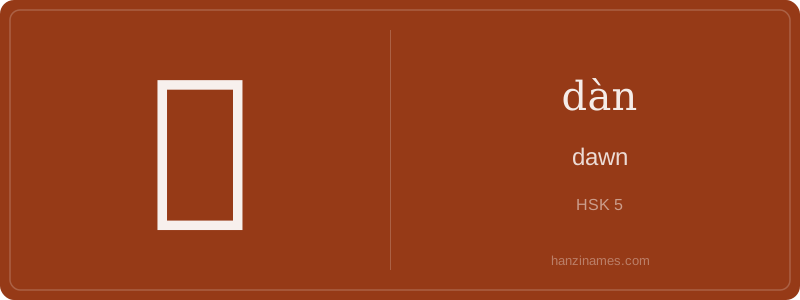
In modern Mandarin, 旦 most commonly appears in formal, literary, or ceremonial contexts—not in casual speech. It’s essential in fixed terms like 元旦 (yuándàn, ‘Chinese New Year’s Day’) and 破晓 (pòxiǎo, ‘daybreak’), and historically appeared in imperial documents dated by ‘year-month-旦.’ The character also names a major role type in traditional Chinese opera—‘dan’ roles (e.g., 青衣 qīngyī), symbolizing purity and grace associated with morning light.
Archaeologically, 旦 appears in early seal script (c. 4th century BCE) as a clear pictograph: 日 (sun) above a horizontal line representing the horizon. No oracle bone form survives, but the Warring States bamboo slips confirm this stable structure—sun poised at the edge of earth, capturing the exact visual moment of dawn.
The character 旦 (dàn) embodies the Chinese philosophical reverence for cyclical time and renewal. Unlike Western linear conceptions of progress, traditional Chinese cosmology sees dawn not as a mere moment but as a sacred hinge—where yin recedes and yang ascends, darkness yields to light, and heaven renews its mandate. This quiet transition reflects a worldview where harmony arises from balance, not conquest; where beginnings are gentle, inevitable, and deeply communal.
Visually, 旦 is a masterclass in minimalist symbolism: the radical 日 (rì, 'sun') forms the upper frame, while the horizontal stroke beneath represents the horizon—the precise line where sun first breaches the earth. This isn’t just description; it’s cosmological cartography. Ancient astronomers tracked solstices using such horizon-aligned observations, embedding celestial precision into daily script.
In classical literature and ritual, 旦 marks thresholds of moral and temporal significance—New Year’s dawn, imperial edicts issued at daybreak, or Confucian scholars rising before sunrise to cultivate virtue. To ‘greet the 旦’ was to align human conduct with cosmic order. Even today, phrases like ‘元旦’ (yuándàn, ‘First Dawn’) carry this layered resonance: not just ‘New Year’s Day,’ but the ceremonial rebirth of time itself.
Example Sentences
Common Compounds
Similar Characters — Don't Mix These Up
Your First Step into Chinese Culture: Get a Chinese Name
Every journey into Chinese begins with a name. Use our free Chinese name generator to create a meaningful, personalized Chinese name that fits you perfectly.
Get My Chinese Name →