智
Character Story & Explanation
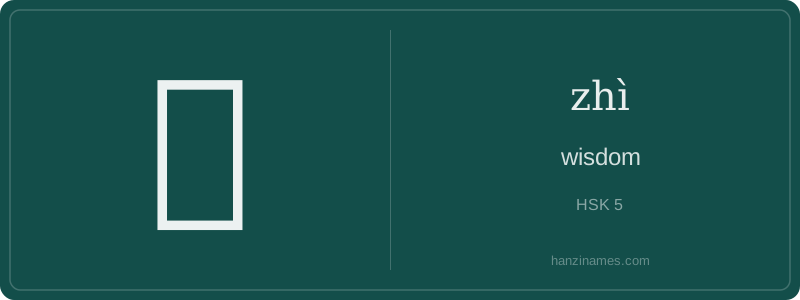
In modern Chinese, 智 appears ubiquitously: in HSK 5 textbooks, government policy documents on 'intelligent manufacturing' (智能制造), and idioms like 足智多谋 (zú zhì duō móu, 'resourceful and sagacious'), long associated with Zhuge Liang, the Three Kingdoms strategist. It’s also central to the Confucian classic *Analects* 2.18: '知之为知之,不知为不知,是知也'—where the final '知' is often interpreted as 智 ('true wisdom lies in knowing the limits of one’s knowledge').
The character is not pictographic. Its earliest attested form (Warring States bronze inscriptions) already combines 知 and 日. While 日 is indeed the semantic radical—linking wisdom to clarity and enlightenment—the full character evolved as a phono-semantic compound, not a visual metaphor. Today, Chinese students encounter it daily in phrases like 智能手机 (zhìnéng shǒujī, 'smartphone'), where 智 conveys 'intelligent capability' grounded in function, not mysticism.
As an archaeologist brushing dust from a Han dynasty bamboo slip, I find 智 inscribed not as a static glyph—but as a layered artifact of cognition. Its upper component, 知 (zhī, 'to know'), anchors it in conscious awareness; the lower 日 (rì, 'sun')—the radical—suggests illumination: wisdom as inner light that dispels ignorance’s shadows. This isn’t mere literacy; it’s epistemic clarity forged in Confucian pedagogy and Legalist statecraft alike.
Excavating further into the *Xunzi* (3rd c. BCE), we see 智 consistently paired with 仁 (rén, 'benevolence') and 勇 (yǒng, 'courage')—forming the triad of virtuous leadership. Unlike Western ‘intelligence’—often measured by logic or speed—ancient Chinese 智 implied moral discernment: knowing *what ought to be done*, not just *what is*. It was tested in governance, not exams.
The character’s twelve-stroke structure reveals disciplined composition: five strokes for 知, seven for 日—yet the radical is placed *below*, defying typical top-radical conventions. This inversion signals humility: wisdom does not sit above experience but grounds itself in the daily rhythm of the sun—the observable, cyclical, and real. It’s a quiet rebellion against abstraction, insisting that true insight emerges only from engaged presence in the world.
Example Sentences
Common Compounds
Similar Characters — Don't Mix These Up
Your First Step into Chinese Culture: Get a Chinese Name
Every journey into Chinese begins with a name. Use our free Chinese name generator to create a meaningful, personalized Chinese name that fits you perfectly.
Get My Chinese Name →