曾
Character Story & Explanation
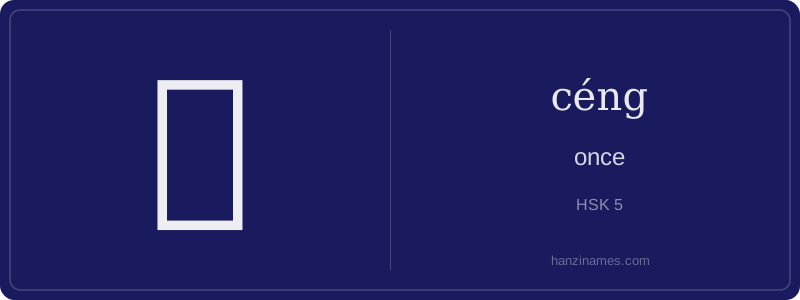
In daily Mandarin, 曾 (céng) functions almost exclusively as an experiential adverb preceding verbs, signaling that an action occurred at least once in the past—never with time markers like 'yesterday' or 'last week'. It appears in formal writing, news reports, and HSK 5+ exams, especially in negative questions ('Have you ever…?') and literary descriptions. Common phrases include 曾经 (céngjīng, 'once/in the past') and 未曾 (wèicéng, 'never'). Historically, it appears in Tang poetry (e.g., Li Bai’s '曾记得'—'I once remembered') and official Qing dynasty memorials documenting past precedents.
The character’s written form has no verified pictographic origin. Unlike 日 or 山, it isn’t traced to a concrete object. Instead, its earliest secure appearance is on Western Zhou bronze vessels (c. 10th–9th c. BCE) as the name of the State of Zeng—a polity whose rulers were recorded using this graph. Today, Chinese learners most commonly encounter 曾 in sentences like '我曾经去过北京'—a real-life phrase used daily in language classrooms and immigration interviews to express prior experience.
As a linguistic detective, I begin with the oracle bone and bronze inscriptions—though 曾 does not appear in earliest forms as a standalone verb meaning 'once'. Instead, its earliest attested use (Zhou dynasty bronze inscriptions) is as a proper noun: a surname and the name of an ancient state. The character’s structure—top radical 曰 (‘to speak’, often stylized as a mouth or ritual container) over two stacked horizontal strokes and a final ‘mouth-like’ base—suggests a ceremonial or ancestral context, possibly linked to lineage records or ancestral rites where repetition and precedent mattered.
By the Warring States period, 曾 began shifting semantically: its phonetic component (zēng) merged with grammatical function, evolving into an adverbial particle marking past experience—'already', 'once', 'ever'. This grammaticalization mirrors patterns seen in other Chinese adverbs like 已 (yǐ) and 过 (guò). Crucially, 曾 never developed pictographic roots like sun (日) or tree (木); it’s a phono-semantic compound where sound drove meaning more than image.
The dual pronunciation reflects this layered history: zēng preserves the original surname/state name reading (still used today in names like 曾国藩), while céng emerged as the grammaticalized adverbial form. Modern Mandarin standardized céng for 'once/ever' and zēng for familial terms (e.g., 曾祖父 zēngzǔfù, 'great-grandfather'), maintaining both pronunciations via strict lexical distribution—not ambiguity, but historical stratification.
Example Sentences
Common Compounds
Similar Characters — Don't Mix These Up
Your First Step into Chinese Culture: Get a Chinese Name
Every journey into Chinese begins with a name. Use our free Chinese name generator to create a meaningful, personalized Chinese name that fits you perfectly.
Get My Chinese Name →