朗
Character Story & Explanation
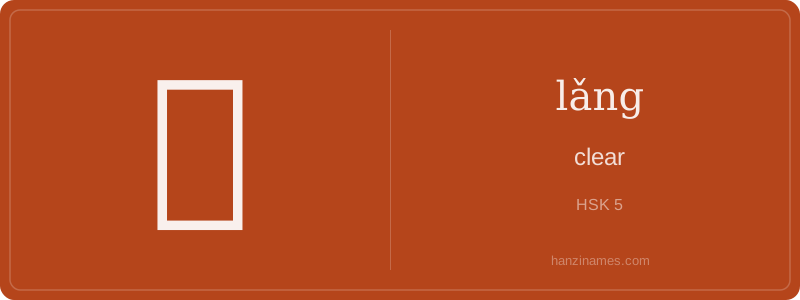
In Beijing’s Confucius Temple, students preparing for the HSK Level 5 exam practice 朗读 (lǎngdú)—‘reading aloud’—a core skill tested in speaking sections. The term appears in official MOE guidelines as essential for Mandarin fluency. Idioms like 朗朗上口 (lǎnglǎng shàngkǒu, 'rolling easily off the tongue') describe memorable, rhythmic phrases. Historically, 朗 was used in Tang dynasty poetry to depict clear moonlight and unclouded skies, reinforcing its association with perceptual and intellectual transparency.
The 月 radical here is a variant of 肉 (ròu, 'flesh'), not moon—it’s a common phonetic-semantic component in characters related to the body or internal states. 良 (liáng) provides both sound and meaning ('good'), making 朗 a phono-semantic compound meaning 'excellently clear'. No oracle-bone or bronze inscriptions survive for 朗; its earliest verified forms appear in Han dynasty bamboo slips.
The character 朗 (lǎng) evokes brightness and clarity—like morning light flooding a courtyard. Though its radical is 月 (moon), it doesn’t refer to lunar cycles; instead, it conveys luminous openness: clear skies, articulate speech, or cheerful disposition. Historically, it appears in classical texts like the *Book of Rites*, describing dignified, resonant voices during ritual recitations—linking vocal clarity with moral integrity.
Visually, 朗 combines 月 (left, suggesting 'body' or 'flesh' in this context—not moon) and 良 (right, meaning 'good' or 'excellent'). In seal script, 良 originally depicted a grain measure, later abstracted to signify quality. Thus, 朗 literally implies 'excellent bodily resonance'—a metaphor for clear, unobstructed expression.
In modern usage, 朗 carries positive, elevated connotations: not just visual clarity, but mental lucidity, emotional brightness, and vocal precision. It’s common in formal or literary contexts—never slang—and often appears in compound words related to reading aloud, weather, or temperament. Its tone (third tone) and crisp articulation mirror its semantic weight: sharp, unhurried, and distinctly intelligible.
Example Sentences
Common Compounds
Similar Characters — Don't Mix These Up
Your First Step into Chinese Culture: Get a Chinese Name
Every journey into Chinese begins with a name. Use our free Chinese name generator to create a meaningful, personalized Chinese name that fits you perfectly.
Get My Chinese Name →