木
Character Story & Explanation
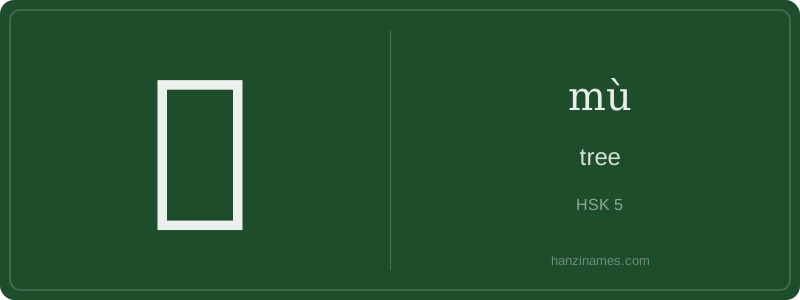
In daily life, 木 appears ubiquitously: on labels for wooden products (e.g., 木制玩具 — 'wooden toys'), in construction permits citing 'timber specifications', and in idioms like 木已成舟 (mù yǐ chéng zhōu — 'the tree has already become a boat'), meaning 'what’s done is done'. It’s also central to the Five Elements (Wu Xing), where 木 represents 'Wood' — symbolizing growth, flexibility, and spring. Historically, 木 was used in early tax records (e.g., Han dynasty bamboo slips) to denote timber levies.
This character originated as a clear pictograph: Oracle Bone Script shows a vertical line (trunk) with two outward strokes (branches) and a short base stroke (roots or ground). Archaeological inscriptions from Yinxu confirm this consistent, tree-like shape — making 木 one of the best-documented pictographs in Chinese writing history.
The character 木 (mù) is one of the most foundational pictographic characters in Chinese — its four-stroke form directly evokes a tree: a vertical trunk with two horizontal branches and a stabilizing base. As both a standalone word meaning 'tree' and the radical for hundreds of wood-related characters, 木 anchors vocabulary around nature, materials, and craftsmanship. Its simplicity belies its centrality: without 木, words like forest (森林), furniture (家具), or even 'simple' (朴素) would lose their conceptual roots.
Historically, 木 appears identically in Oracle Bone Script (c. 1200 BCE) and Bronze Inscriptions — among the earliest confirmed Chinese writings — confirming its ancient pictorial origin. Unlike abstract or phonetic characters, 木 was drawn to resemble a stylized tree: upright trunk, symmetrical limbs, and grounded base. This visual fidelity made it instantly recognizable across millennia, reinforcing its role as a semantic anchor in Chinese script.
In modern usage, 木 carries subtle cultural resonance beyond botany. It evokes natural harmony, humility (as in 木讷 — 'taciturn, unassuming'), and traditional craftsmanship (e.g., woodworking masters called 木匠). Even in urban life, 木 surfaces in everyday contexts — from wooden chopsticks (木筷) to timber construction standards (木材标准) — reminding speakers of humanity’s enduring material and philosophical ties to trees.
Example Sentences
Common Compounds
Similar Characters — Don't Mix These Up
Your First Step into Chinese Culture: Get a Chinese Name
Every journey into Chinese begins with a name. Use our free Chinese name generator to create a meaningful, personalized Chinese name that fits you perfectly.
Get My Chinese Name →