架
Character Story & Explanation
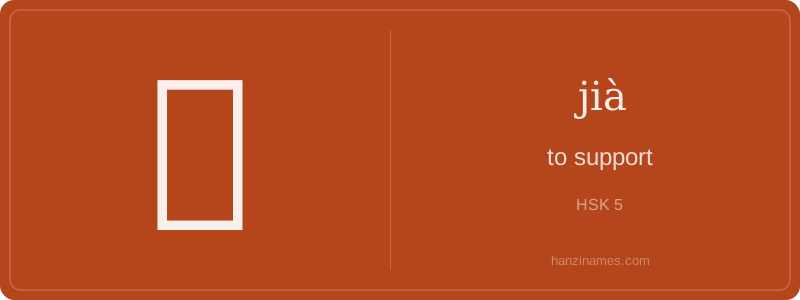
In Beijing’s Panjiayuan Antique Market, vendors routinely use 架 to describe how they display calligraphy scrolls—‘用红木架撑起来’ (yòng hóngmù jià chēng qǐlái, ‘prop them up with rosewood frames’). This reflects its enduring role in material culture: 架 appears in Song dynasty engineering manuals describing scaffolding (脚架, jiǎojià) for temple construction and remains central in today’s technical lexicon—e.g., 机架 (jījià, ‘server rack’) in data centers across Shenzhen.
The character’s form is a clear semantic-phonetic compound: 木 (wood, radical) + 加 (jiā, phonetic component, also meaning ‘to add’). While 加 doesn’t mean ‘support,’ its inclusion signals pronunciation and subtly reinforces the idea of *adding structure*. No oracle-bone origin exists; it first appeared in seal script (c. 3rd century BCE) as a standardized logograph for wooden supports—verified in excavated bamboo slips from the Qin dynasty.
The character 架 (jià) visually embodies its meaning: the left side 木 (mù) is the ‘wood’ radical, reflecting its ancient function as a wooden support structure—like a shelf, beam, or frame. Historically, it appeared in texts as early as the Han dynasty to denote physical frameworks used in architecture and agriculture. Its semantic core remains ‘to hold up’ or ‘to prop,’ extending metaphorically to abstract support like ‘supporting an argument’ or ‘sustaining a relationship.’
Though often misread as merely ‘shelf,’ 架 carries dynamic action: it’s a verb first, then a noun. You don’t just *have* a shelf—you *jià* something *on* it. This verbal force appears in compounds like 架设 (jiàshè, ‘to install’ a bridge or network) and 架空 (jiàkōng, ‘to sideline’—literally ‘to lift into air,’ implying removal from real influence). It conveys intentionality: support isn’t passive—it’s deliberate construction.
In modern usage, 架 bridges tangible and institutional realms: from setting up 5G base stations (基站架设) to ‘framing’ a legal case (架起证据链, ‘building an evidentiary chain’). Even in slang, 架 can imply posturing—e.g., 架势 (jiàshi, ‘showy stance’) hints at performative support. Its nine-stroke form is compact yet stable—mirroring the structural reliability it signifies. At HSK 5, learners encounter it not as vocabulary alone, but as a conceptual keystone for understanding how Chinese expresses agency through physical metaphors.
Example Sentences
Common Compounds
Similar Characters — Don't Mix These Up
Your First Step into Chinese Culture: Get a Chinese Name
Every journey into Chinese begins with a name. Use our free Chinese name generator to create a meaningful, personalized Chinese name that fits you perfectly.
Get My Chinese Name →