桃
Character Story & Explanation
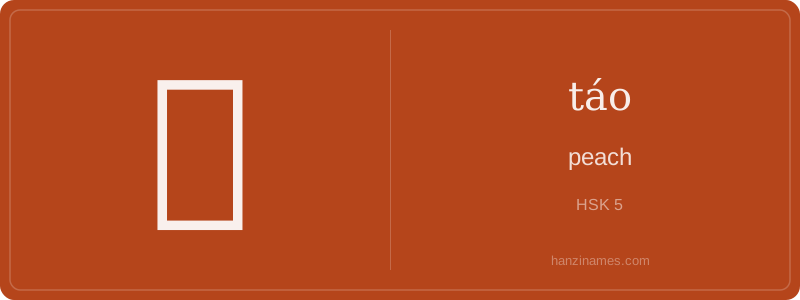
In daily life, 桃 appears ubiquitously: on supermarket labels (水蜜桃 shuǐmìtáo ‘honey peach’), in health supplements (桃仁 táorén ‘peach kernel’), and in idioms like ‘世外桃源’ (shìwài táoyuán ‘Peach Blossom Spring’), referencing Tao Yuanming’s 4th-century utopian fable—still taught in all Chinese middle schools. Historically, peach wood was used in Zhou dynasty (1046–256 BCE) talismans to ward off evil, a practice documented in the *Rites of Zhou*.
The character is a phono-semantic compound: 木 (mù, ‘tree’) as semantic indicator, 兆 (zhào, archaic pronunciation *tiao*) as phonetic component. No oracle bone form survives, but its earliest secure appearance is in Warring States bamboo slips (c. 4th century BCE), where it consistently denotes the fruit or tree—never abstract concepts. Its form stabilized by the Qin standardization (221 BCE).
As an archaeologist sifting through layers of Chinese script, I trace 桃 not to mythic orchards but to tangible Bronze Age realities: its earliest attested form in the Warring States bamboo texts (c. 475–221 BCE) already bears the 木 (tree) radical and 兆 (zhào) phonetic—confirming it was a lexicalized, cultivated fruit, not a poetic abstraction. This wasn’t a character born of oracle-bone divination, but of agricultural record-keeping: tax rolls, herbal manuals, and ritual inventories listing peach wood for exorcism.
The radical 木 anchors 桃 firmly in the botanical realm—no ambiguity here: this is a woody, flowering tree species, *Prunus persica*, domesticated in the Yangtze and Yellow River basins by 3000 BCE. Excavations at Hemudu (7000 BP) reveal peach stones in storage pits; later Shang dynasty oracle bones mention ‘peach groves’ in royal estates. The character’s structure reflects bureaucratic precision: a named tree, not just ‘fruit’ or ‘sweet thing’—a distinction vital for land surveys and tribute lists.
What makes 桃 archaeologically compelling is its functional duality: it appears both in medicinal texts (e.g., *Shennong Bencao Jing*, 1st c. CE) prescribing peach kernels for blood stasis, and in Han dynasty tomb murals showing immortals holding peaches—proof that symbolic meaning emerged *after* material use. Unlike invented ‘sun + moon = brightness’ etymologies, 桃’s evolution is empirically verifiable: from agrarian ledger → pharmacopeia → literary motif. Its stability across 2,300 years of script reform underscores how deeply rooted it is in China’s ecological and administrative soil.
Example Sentences
Common Compounds
Similar Characters — Don't Mix These Up
Your First Step into Chinese Culture: Get a Chinese Name
Every journey into Chinese begins with a name. Use our free Chinese name generator to create a meaningful, personalized Chinese name that fits you perfectly.
Get My Chinese Name →