梳
Character Story & Explanation
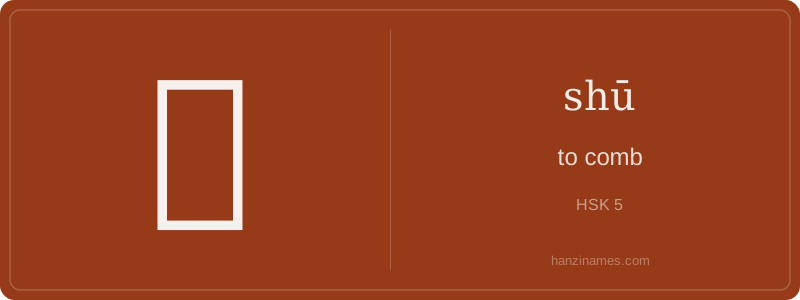
In daily life, 梳 is most commonly used in verbs like 梳头 (shū tóu, 'to comb one’s hair') and in compound nouns like 梳子 (shūzi, 'comb'). Historically, it appears in Tang-dynasty poetry describing courtly grooming and in Ming-era medical texts advising regular hair-combing for qi circulation. A well-documented idiom is 梳理 (shūlǐ), meaning 'to sort out' or 'to systematize' — extended metaphorically from physical combing to intellectual organization, widely used in modern administration and education.
The character is not pictographic — no oracle-bone or bronze inscription survives. Its earliest confirmed form is in Han clerical script. Today, Chinese people use 梳 routinely in beauty routines, parenting ('帮宝宝梳头发'), and hairstyling contexts — often paired with mirrors and hair ties, reflecting its enduring role in personal care and social presentation.
As a linguistic detective, I begin with the modern form of 梳: eleven strokes, anchored by the 木 (wood) radical on the left — an immediate clue. This isn’t coincidental: combs in ancient China were predominantly carved from wood, bone, or ivory, and the radical signals material origin, not just abstract function. The right side, 疏 (shū), is phonetic but also semantically rich — meaning 'sparse', 'to disperse', or 'to regulate', subtly echoing the action of separating tangled hair.
Tracing backward, 梳 appears reliably in clerical script (Lìshū) from the Han dynasty (206 BCE–220 CE), already bearing its current structure. Unlike characters with contested oracle-bone origins, 梳 lacks pre-Qin inscriptions — suggesting it emerged later as a specialized tool-word, likely coined when personal grooming became codified in ritual texts and medical manuals like the Huangdi Neijing. Its stability across 2,000 years reflects how deeply embedded combing was in hygiene, etiquette, and even Daoist self-cultivation practices.
The character’s design reveals a functional logic: 木 grounds it in tangible craft; 疏 provides both sound and conceptual nuance — to ‘comb’ is to ‘thin out’, ‘order’, and ‘prepare’. This duality makes 梳 more than a verb: it’s a microcosm of classical Chinese semantics, where form, sound, and meaning coalesce with precision. No stroke is decorative; each serves etymological duty — a testament to how Chinese writing encodes material culture, phonology, and philosophy in a single glyph.
Example Sentences
Common Compounds
Similar Characters — Don't Mix These Up
Your First Step into Chinese Culture: Get a Chinese Name
Every journey into Chinese begins with a name. Use our free Chinese name generator to create a meaningful, personalized Chinese name that fits you perfectly.
Get My Chinese Name →