权
Character Story & Explanation
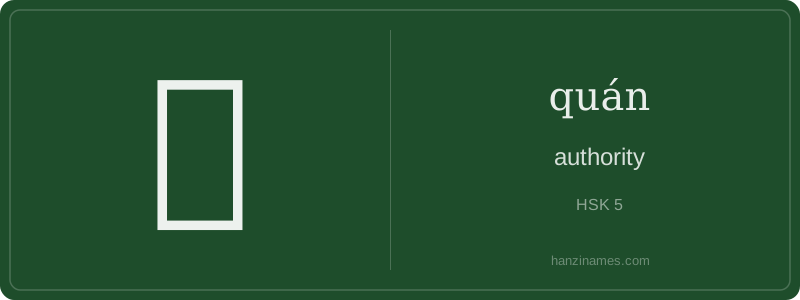
In modern China, 权 appears ubiquitously in legal, political, and corporate contexts: citizens ‘exercise their rights’ (行使权利), officials ‘use power according to law’ (依法用权), and companies define ‘decision-making authority’ (决策权). A well-documented idiom is 大权在握 (dà quán zài wò)—‘great authority rests in one’s grasp’—used since the Ming dynasty to describe centralized control, notably in imperial edicts and Qing-era administrative records.
The character’s form evolved from seal script: the left 木 (mù, ‘tree’) radical originally signified a wooden tally or token used in ancient times to verify official authorization—like a carved wooden tablet split between two parties. The right side 廾 (gǒng, ‘hands holding’) + 王 (wáng, ‘king’) later simplified to 又, reflecting delegation of royal mandate. No oracle bone form survives, but bronze inscriptions confirm its early link to ceremonial tokens of delegated power.
The character 权 (quán) embodies a deeply relational concept of authority in Chinese thought—not as absolute power, but as the measured, context-sensitive right to act or decide. Rooted in Confucian and Legalist traditions, authority is never detached from responsibility, ritual propriety (li), or moral legitimacy (de). To ‘hold authority’ implies stewardship: one wields it only so long as one acts justly and serves the collective good.
This worldview rejects authoritarianism as illegitimate; instead, authority must be earned, delegated, and continually justified through benevolent action. The Mandate of Heaven (天命) historically framed rulers’ 权 as conditional—revocable if they failed moral governance. Even today, official discourse emphasizes ‘exercising power in accordance with law’ (依法用权), underscoring that 权 is inseparable from accountability and public trust.
Unlike Western notions privileging individual sovereignty, 权 reflects a systemic, role-based understanding: a teacher holds educational authority, a parent familial authority, a judge judicial authority—each bounded by ethical norms and social harmony. This makes 权 inherently dynamic, contextual, and communal—a ‘right-to-act’ calibrated not by force, but by function, virtue, and consensus.
Example Sentences
Common Compounds
Similar Characters — Don't Mix These Up
Your First Step into Chinese Culture: Get a Chinese Name
Every journey into Chinese begins with a name. Use our free Chinese name generator to create a meaningful, personalized Chinese name that fits you perfectly.
Get My Chinese Name →