歪
Character Story & Explanation
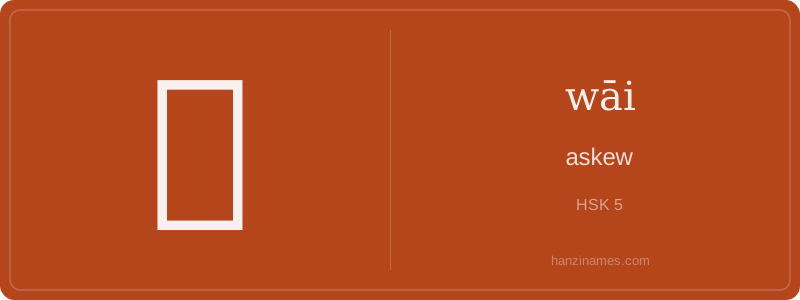
歪 is ubiquitous in modern Mandarin for describing physical or metaphorical misalignment: a crooked picture frame (歪着挂), a slanted smile (歪嘴笑), or biased judgment (歪曲事实). It appears in the common idiom 歪打正着 (wāi dǎ zhèng zháo)—‘hitting the target by aiming askew’—meaning accidental success, documented since the Ming dynasty in vernacular novels like *Jin Ping Mei*. The phrase underscores how 歪 carries neutral-to-positive connotations in context, unlike pejorative terms like 偏 (biased) or 错 (wrong).
The character’s structure is a clear semantic-phonetic compound: 止 (radical, indicating ‘stance’ or ‘position’) + 不 (phonetic component, approximating ancient pronunciation). No oracle-bone or bronze inscription evidence exists for 歪—it first appears reliably in Song-dynasty dictionaries. So instead, imagine a Beijing hutong resident today adjusting a leaning roof tile, muttering ‘这瓦片又歪了!’—a real, daily use rooted in tangible, observable imbalance.
As an archaeologist sifting through layers of linguistic sediment, I find 歪 not in oracle bones—but in the quiet rebellion of script. Its form is a deliberate visual paradox: 止 (‘to stop’, a stable base) fused with 不 (‘not’), suggesting ‘not stopping straight’—a conceptual fossil of imbalance made visible. This isn’t a pictograph of crookedness, but a logical compound born in the Warring States period, when philosophers and scribes began encoding abstract states through juxtaposition rather than imitation.
The character’s dual pronunciation—wāi (standard) and wǎi (regional/colloquial, preserved in some northern dialects and opera)—reveals phonological stratigraphy. Wǎi echoes older Middle Chinese *ʔuʌj, where the glottal stop softened regionally. Linguistic excavations show wǎi still appears in Shanxi folk songs and Beijing opera stage directions, marking intentional, performative skew—like a tilted head conveying irony or suspicion.
Its radical 止 is no accident: it anchors the idea of deviation *from* stasis. In classical texts like the *Shuōwén Jiězì* (121 CE), 歪 is glossed as ‘not upright; bent sideways’, confirming its semantic core was always relational—not absolute crookedness, but misalignment relative to an expected axis. This nuance survives today: 歪 is never used for pathological deformity (that’s 歪斜 or 畸形), but for playful, temporary, or socially readable tilt—like a hat worn at a jaunty angle.
Example Sentences
Common Compounds
Similar Characters — Don't Mix These Up
Your First Step into Chinese Culture: Get a Chinese Name
Every journey into Chinese begins with a name. Use our free Chinese name generator to create a meaningful, personalized Chinese name that fits you perfectly.
Get My Chinese Name →